
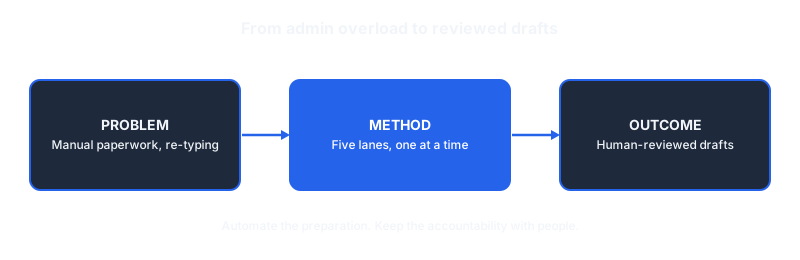
Your best adviser spends Monday morning renaming PDFs. That is the problem this post is about.
Financial services firms run on documents, checklists and follow-ups. Most of that work is repetitive, rule-based and a poor use of a qualified person's week. Dominik Gabor, an AI automation consultant based in the Netherlands, helps European SMEs turn that admin into reviewed drafts, and this guide shows how to do it in a regulated setting without giving up control.
You will get five workflows in a fixed order, a clear line between what to automate and what to keep human, and five privacy questions to answer before any client data touches a tool.
AI automation for financial services connects your existing tools, adds an AI step that reads documents or drafts text, and routes every output to a person for review. It handles the preparation around client work: intake, filing, checks, drafts and reports. It does not make advice or credit decisions.
Key Takeaways
- Automate preparation, not accountability: AI drafts and extracts. A qualified person approves anything that reaches a client.
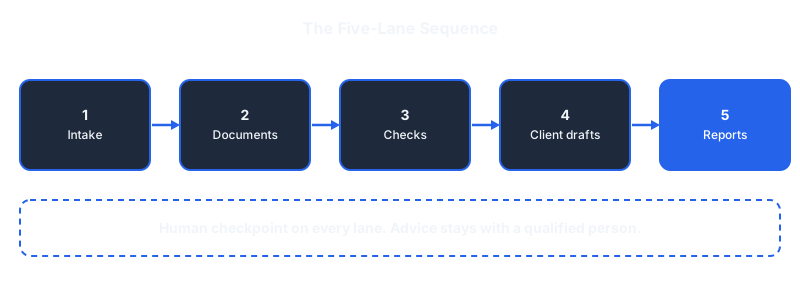
- Five lanes, in order: intake, documents, checks, client drafts, reports.
- Start with document extraction: high volume, clear rules, and a review queue catches errors early.
- Ask the privacy questions first: where data is processed, whether it trains models, who has access.
- Measure the baseline: time your manual process before you build so the saving is real.
Why Financial Services Firms Are a Strong Fit for AI Automation
Financial services runs on paper, even when the paper is a PDF. A client sends a payslip, a bank statement, an ID scan and a signed form. Someone on your team opens each one, reads it, types the numbers into another system and files it.
That is the work AI automation handles well. It reads a document, pulls out the fields, checks them against a rule and flags anything odd. The person then reviews a finished draft instead of starting from a blank screen.
The catch is the word "regulated". You cannot hand a client a machine-written answer and hope for the best. So the goal here is narrower than "automate the firm". The goal is to automate the admin around each client and keep a qualified person on every decision that carries advice or liability.
Dominik Gabor, an AI automation consultant based in the Netherlands, uses the same rule with every regulated client type: automate the preparation, never the accountability. The five workflows below follow that rule.
The Five-Lane Sequence: What to Automate, in Order

Most firms try to automate everything at once and end up with five half-working workflows. Build one lane at a time, in this order. Each lane feeds the next one clean data.
Lane 1: Client Intake and Onboarding
What it does: A new enquiry arrives through your form or inbox. The workflow logs it in your CRM, sends the right document checklist and books a first call. Nothing here involves advice.
Human checkpoint: A team member confirms the client type and approves the checklist before it goes out, for the first month.
Tool stack: n8n or Make, your CRM, Gmail or Outlook, and Claude for classifying the enquiry.
Lane 2: Document Extraction and Filing
What it does: Client documents land in a shared folder. The workflow reads each one, extracts the fields you care about, names the file consistently and stores it in the right client record.
Human checkpoint: Every extraction goes to a review queue. A person approves or corrects it before the data is used anywhere else.
This is the best first lane. It is high volume, the rules are clear, and the review step catches errors while they are cheap. Read the step-by-step workflow migration guide before you build it, because the parallel-run method in that post applies directly.
Lane 3: Checks and Exception Flagging
What it does: The workflow compares extracted data against your internal checklist and flags gaps: a missing signature, a document older than your policy allows, a name that does not match across two files.
Human checkpoint: Your compliance officer owns the rules. The workflow applies them and never changes them.
You are checking a client file against a fixed checklist.
Checklist items: {checklist}
Extracted data: {fields}

For each checklist item, output one line:
"OK: [item]" or "MISSING: [item] - [what is missing]".
Do not guess. If a value is unclear, write "UNCLEAR: [item]".
Do not give advice. Do not summarise the client's situation.
Lane 4: Client Communication Drafts
What it does: Meeting transcripts and file updates become draft follow-up emails, status updates and reminders in your firm's tone. Writing a good prompt without the common mistakes matters more here than any tool choice.
Human checkpoint: Drafts wait in the adviser's drafts folder. Nothing is sent automatically. The adviser edits, approves and sends.
Lane 5: Recurring Reports
What it does: Each month or quarter the workflow pulls figures from your systems, writes the commentary draft and lays out the report in your template.
Human checkpoint: The responsible adviser reads the numbers and the commentary before the report reaches the client.
Where Humans Must Stay in the Loop
A simple test keeps you safe. If the output could change a client's decision or your firm's liability, a qualified person signs it off. If the output only prepares work for that person, automate it.
| Task | Automate? | Who signs off |
|---|---|---|
| Document intake and filing | Yes, with review queue | Operations team |
| Checklist and completeness checks | Yes | Compliance officer sets the rules |
| Follow-up and reminder emails | Draft only | Adviser or broker |
| Report assembly | Draft only | Responsible adviser |
| Suitability, product advice, credit decisions | No | Qualified professional |
The last row is the important one. AI can prepare the file, but the recommendation itself stays a human judgment, and your firm remains accountable for it. The EU AI Act draws the same line: it classifies AI that evaluates a person's creditworthiness or credit score, and AI used for risk assessment and pricing in life and health insurance, as high-risk (European Parliament and Council, 2024, Annex III).
This is also what Dutch supervisors see in practice. Financial institutions keep a human in the loop: an employee assesses the AI-generated result before it is used, and that employee, and ultimately management, stays responsible for the content (AFM & DNB, 2024).
Data Privacy and Compliance: Ask These Questions First
Client financial data is sensitive. Before you connect any tool to it, get written answers to five questions.
- Where is the data processed and stored, and can you choose an EU region?
- Does the provider use your data to train its models, and can you turn that off?
- Who at your firm has access, and is every action logged?
- Can you delete a client's data on request, everywhere it was copied?
- Does your supervisor or professional body have guidance on AI use that applies to you?
For Dutch and German firms, self-hosting the workflow layer with n8n keeps orchestration on infrastructure you control. It does not remove your obligations, so involve your compliance officer and, where needed, your legal adviser before go-live. The EU AI Act guide for Dutch SMEs covers what applies to businesses of your size and what moved to 2027.
On the fifth question, there is already an answer in the Netherlands. The AFM and DNB say their supervision standards are technology-agnostic and apply just as well when AI is used, so the rules you work under today still cover the workflow (AFM & DNB, 2024). For the insurance sector, EIOPA published an Opinion on AI governance and risk management in August 2025 that explains how existing insurance rules apply when insurers use AI (EIOPA, 2025).
A Worked Example: A 12-Person Insurance Brokerage

This is a hypothetical firm, used to show the sequence. It is not a client case and the numbers are illustrative.
A brokerage in Utrecht has 12 people and handles renewals for a few hundred business clients. Each renewal needs an updated questionnaire, a set of supporting documents and a comparison of insurer quotes. Two assistants spend most of the week chasing documents and re-typing data.
Weeks 1 to 2: Map one renewal from start to finish. Count the touches. Choose Lane 2, document extraction, as the pilot.
Weeks 3 to 4: Build the extraction workflow with a review queue. Run it in parallel with the manual process for one full renewal cycle.
Weeks 5 to 8: Switch over. Add Lane 3 so missing documents are flagged the day they arrive rather than the week before the deadline.
Weeks 9 to 12: Add Lane 4, draft reminders to clients, sitting in the broker's drafts folder for approval.
The measurable outcome is simple: hours per renewal, and the number of renewals that reach the deadline with a complete file. Track both before you start, so you can compare honestly afterwards.
Five Mistakes Financial Firms Make With AI Automation
- Automating advice instead of preparation. The value is in the admin. The risk is in the recommendation.
- Skipping the review queue. Without it, an extraction error travels straight into a client record.
- Connecting client data before asking the privacy questions. Fixing this afterwards is far harder than asking first.
- Building all five lanes at once. Each lane needs a full reporting cycle to prove itself.
- Not measuring the baseline. If you did not time the manual process, you cannot show the saving.
Costs vary widely by firm size and scope. The AI automation pricing guide breaks down what to expect so you can budget before you start.
What This Means for Firms in the Netherlands and Germany
In the Netherlands and Germany, clients expect careful handling of their financial data, and supervisors expect firms to know exactly what their tools do. That favours a controlled, step-by-step rollout with logs and named owners, which is what the five lanes give you.
Small firms in Amsterdam, Rotterdam, Frankfurt and Munich often run lean back offices, so recovering assistant time can change how many clients one adviser can serve. If your client-facing side is busy, the same principles apply to inboxes, covered in the guide to AI customer support automation for SMEs.
Find your first safe lane before you build
In 30 minutes we look at how work moves through your firm, pick the one lane worth automating first, and mark where a qualified person must stay in the loop.
- The admin lane with the fastest payback
- Where the human checkpoints belong
- A baseline metric you can measure
30 minutes. No obligation. No pitch unless you ask for one.
Or grab the free resources first →Frequently Asked Questions
What can a financial services firm automate with AI?
Intake and onboarding paperwork, document extraction, routine client emails, meeting notes, and recurring reports are the strongest starting points. These tasks follow repeatable rules and produce drafts a qualified person can review. Advice, suitability decisions and final compliance sign-off stay with people.
Is AI automation allowed in a regulated financial firm?
Using AI tools is not banned by default, but your firm stays responsible for every output that reaches a client. Check your supervisor's guidance and your compliance officer's view before you connect client data to any tool. Start with internal, low-risk workflows and keep a human approval step on anything client-facing.
Does AI automation replace financial advisers or brokers?
No. It removes the admin around the client relationship: chasing documents, re-keying data, drafting follow-ups and building reports. The judgment, the conversation and the accountability remain human work. Firms that treat AI as an assistant to the adviser get better results than firms that try to remove the adviser.
How long does it take to automate a workflow in a small financial firm?
A single well-scoped workflow, such as document intake with a review queue, usually takes one to three weeks to design, build and test. A full five-workflow rollout is realistically a quarter of steady work. The timeline depends more on how clear your current process is than on the tools.
Where should a financial services SME start with AI?
Start with client document intake. It is high volume, rule-based, easy to measure and low risk because a person reviews every extraction before it is used. Once that runs cleanly for a full reporting cycle, add the next workflow.
The Bottom Line
Financial services firms are a strong fit for AI automation when they automate preparation and keep accountability with people. Build the five lanes in order, intake, documents, checks, client drafts, reports, put a named human checkpoint on each, and give every lane one full reporting cycle before you add the next.
None of this replaces the adviser or the broker. It gives them back the hours that admin used to take, so more of the week goes to the conversations only they can have.
The Five-Lane Sequence
References
- AFM & DNB. (2024, April 9). The impact of AI on the financial sector and supervision. Autoriteit Financiële Markten and De Nederlandsche Bank. afm.nl
- EIOPA. (2025, August 6). Opinion on artificial intelligence governance and risk management (EIOPA-BoS-25-360). European Insurance and Occupational Pensions Authority. eiopa.europa.eu
- European Parliament and Council of the European Union. (2024). Regulation (EU) 2024/1689 laying down harmonised rules on artificial intelligence (Artificial Intelligence Act), Annex III. Official Journal of the European Union. eur-lex.europa.eu

About Dominik Gabor
AI Automation Consultant based in the Netherlands. Dominik helps small and mid-size businesses implement AI automation, from document workflows to reporting systems. He has spent 2+ years testing 27+ AI tools daily, and writes to give business owners the exact, practical starting points that most AI content skips over.