
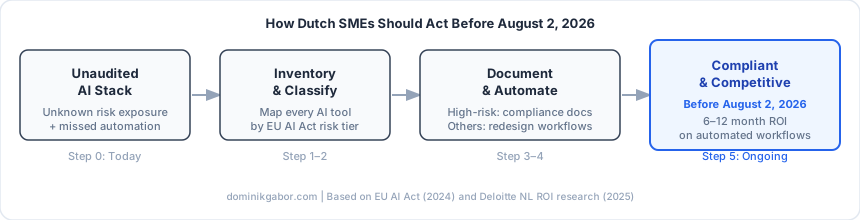
August 2, 2026 is not a suggestion. On that date, the EU AI Act's requirements for high-risk AI systems become enforceable across every EU member state, including the Netherlands. Fines reach up to €35 million or 7% of worldwide annual turnover for the most serious violations. (EU AI Act, 2024)
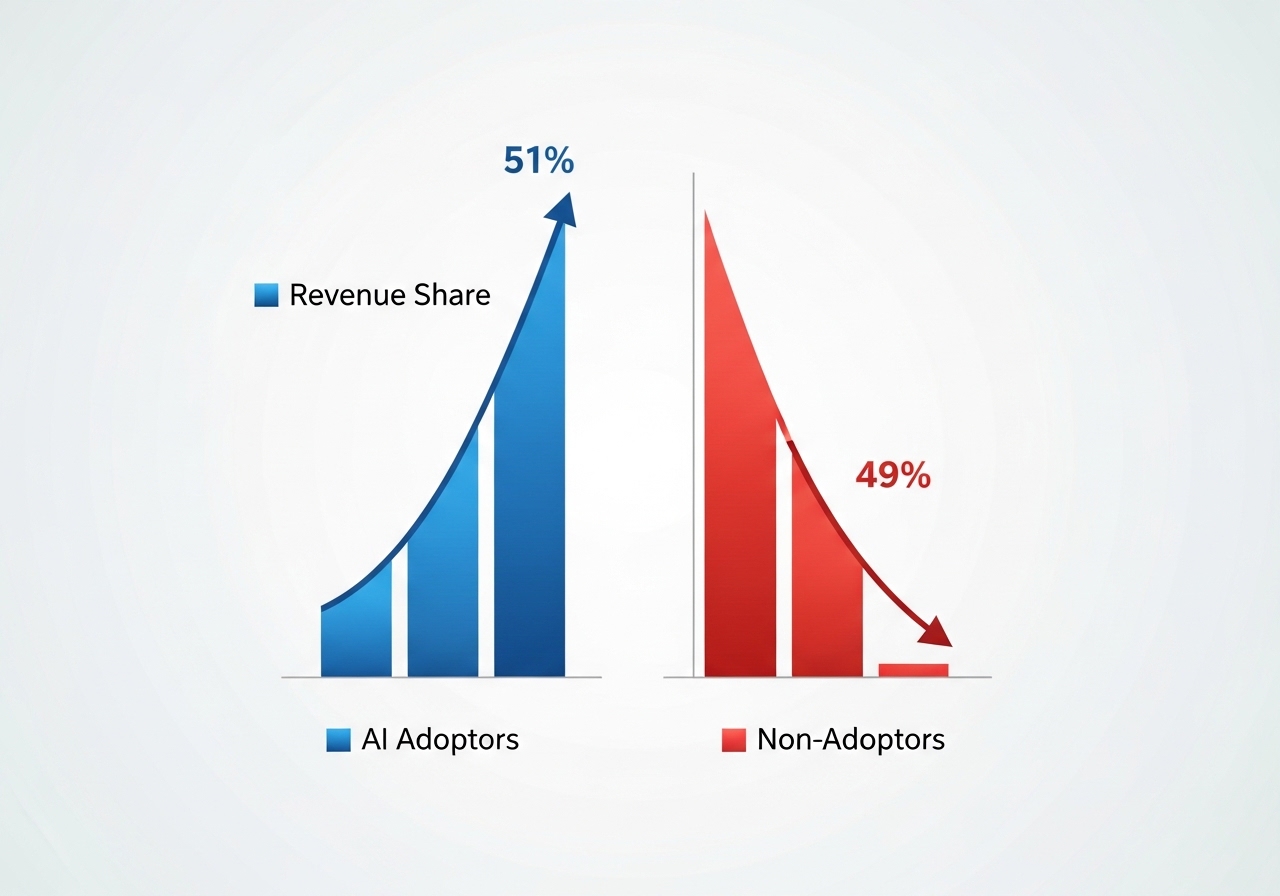
Here is what makes this urgent beyond the compliance angle: 22% of Dutch businesses have already deployed real AI, and those companies now account for 51% of total Dutch enterprise revenue, despite being less than a quarter of all businesses. (Statistics Netherlands (CBS), 2024) The gap between AI adopters and the rest is not widening slowly. It compounds every quarter.
Dominik Gabor, an AI automation consultant in the Netherlands who works with Dutch and European SMEs on workflow implementation and AI compliance, tracks both sides of this equation. The business case for AI adoption and the compliance obligations that come with it are not separate conversations. They are the same conversation.
The August 2026 deadline is 4.5 months away. Here is what you actually need to know and do.
The EU AI Act is the world's first comprehensive legal framework regulating AI systems. Compliance means classifying your AI tools by risk level, meeting documentation and transparency requirements for high-risk applications, and ensuring AI that affects people's rights, safety, or livelihood operates under human oversight. For most Dutch SMEs, the compliance burden is proportionate, but it requires knowing which category your tools fall into before enforcement begins.
What the EU AI Act Actually Means for Your Business
Most coverage of this regulation is written for large enterprises and AI developers. That is the wrong frame if you run a 10-to-50-person business in the Netherlands.
The EU AI Act does not regulate AI broadly. It regulates AI by risk level. The overwhelming majority of tools Dutch SMEs use (email assistants, basic chatbots, workflow automation, content generation) fall into the minimal-risk category. They require essentially no compliance action beyond basic transparency if customer-facing.
High-risk systems are a specific, enumerated list. If your business uses AI to make or materially assist decisions in these areas, hiring and staff evaluation, credit assessment, medical or healthcare decisions, educational grading, law enforcement support, you are in scope for the high-risk rules. The classification is based on use case, not on the underlying technology.
The deadline for those high-risk rules moved. The Digital Omnibus on AI, published in the Official Journal on 24 July 2026 and in force since 27 July 2026, pushed the compliance date for stand-alone high-risk systems from 2 August 2026 to 2 December 2027. High-risk AI embedded in regulated products moved further out, to 2 August 2028 (Gibson Dunn, 2026).
What did not move is transparency. Article 50 applied on schedule from 2 August 2026, and it is the part that touches ordinary Dutch SMEs rather than AI developers. If customers interact with a chatbot, if you publish AI-generated images or video, or if you use emotion recognition, you owe a disclosure. Systems already on the market before that date get a grace period until 2 December 2026 for the watermarking requirement specifically (Jones Walker, 2026).
So the practical position for most Dutch SMEs is close to the opposite of what a high-risk countdown implied. The obligation that actually bites arrived in August 2026 and is comparatively cheap to meet: label the AI, and tell people when they are dealing with a machine. The expensive documentation work, meaning the risk management process, data governance records, human oversight protocols and technical logs, applies to a narrow set of high-risk use cases and is not due until December 2027.
That extra time is not a reason to ignore it. It is a reason to find out which category you are in while doing so is still cheap.
The Netherlands has designated the Autoriteit Persoonsgegevens (AP) and the Rijksinspectie Digitale Infrastructuur (RDI) as coordinating supervisory authorities, with sector-specific regulators including the AFM and DNB covering financial services. (Dutch regulatory framework, 2025) The enforcement infrastructure is in place.
The Business Urgency Behind the Compliance Deadline
The EU AI Act compliance deadline is one reason to act before August 2026. The competitive gap is a more pressing one.
22.7% of Dutch companies with 10 or more employees actively use AI, up from 13.7% in 2023, a 9-point increase in a single year. (CBS, 2024) Those companies now account for 51% of total Dutch enterprise revenue. (CBS, 2024) 84% of Dutch SMEs plan to increase AI investment over the next three years, the highest rate of any European country surveyed. (Wolters Kluwer, 2025)
That concentration of revenue is not a coincidence. It is compounding advantage.
The Cost of Not Acting, Quantified
For a 20-person Dutch SME with €500K quarterly revenue, the estimated monthly competitive disadvantage against an AI-enabled competitor is approximately €5,250 in excess labor costs for equivalent output. That compounds to around €63,000 per year. (Derived from CBS data and automation industry benchmarks, 2024)
The ROI timeline for focused, specific-workflow automation is 6 to 12 months. For high-volume repetitive workflows, payback arrives in 4 to 5 months. (Deloitte NL, 2025) 88% of Dutch businesses that adopted AI report revenue growth averaging 27%. (Wolters Kluwer, 2025) For a €2M revenue SME, that translates to €540,000 in additional annual revenue.
BCG research confirms the long-run trajectory: AI leaders achieve 1.5x higher revenue growth, 1.6x greater shareholder returns, and 1.4x higher return on invested capital versus laggards over a three-year period. (BCG, 2024)
Why Most Dutch SMEs Are Still Stuck
95% of Dutch organizations have adopted some form of AI tool. Only about 5% see measurable real value from it. (Dutch AI industry research, 2025) The top barrier is a lack of experience and skills, and that gap is exactly where external implementation support pays for itself. For the full breakdown of adoption rates by company size, sector, and the specific barriers holding each back, see Dutch AI Adoption Rates by Company Size (2026).
Want to know exactly where your business sits on the adoption curve and which of the AI Act's rules now apply to your specific tools? Book a free 30-minute AI Profit Assessment, we'll map your current AI stack and flag any compliance exposure.
What an AI Stack Audit Actually Uncovers

A Dutch manufacturing company with 28 employees. Established clients, solid margins, no existential concerns about the fundamentals. They had been using a CRM with an AI scoring feature, an AI-assisted email tool for sales outreach, and ChatGPT for drafting supplier correspondence.
They believed they were ahead of the market. In one sense, they were. 78% of Dutch companies their size had deployed nothing.
The audit surfaced three issues they had not anticipated.
First, the CRM's AI scoring feature was making ranked recommendations for evaluating job applicants through an internal HR module. That falls directly into the EU AI Act's employment decision category, an Annex III high-risk use case. They had no documentation of how the model weighted its scores, no human oversight protocol logged anywhere, and no audit trail. As of August 2, 2026, that exposure is live.
Second, the email automation tool was generating and sending responses without a content review step. A sample audit found that 11% of outgoing messages contained factual errors that had already reached clients, including two with incorrect pricing.
Third, none of the AI tools were connected. Each was a standalone tool that staff switched between manually. The actual time savings from their AI investment were near zero, because the workflow around the tools had never been redesigned.
This is the exact pattern that separates the 95% who adopt AI tools from the 5% who generate real value from them. The tools are available to everyone. The workflow architecture is not.
After two months of structured implementation (a redesigned outreach sequence, a proper CRM automation that connected intake to follow-up without manual handoffs, and compliance documentation for the high-risk scoring feature) their sales outreach response rate moved from 6% to 14%, and the team recovered 11 hours per week that had been spent on manual administrative coordination.
Across two years of working with European SMEs and testing 27+ AI tools in live business environments, this pattern repeats consistently. The bottleneck is never the technology. It is always the workflow design and the governance structure around it.
Your 5-Step Action Plan
Four and a half months is enough time to do this properly. It is not enough time to ignore it until summer.
-
Inventory every AI system your business uses.
Include SaaS platforms with AI features built in: your CRM, HR software, customer support tools, analytics platforms. Include any custom integrations, API-connected tools, and AI-generated content in customer-facing channels. Most businesses discover 8 to 12 AI touchpoints they had not formally tracked. You cannot classify what you have not listed.
-
Classify each tool by risk tier.
Map each tool against the EU AI Act's four-tier system: prohibited (banned outright, including social scoring and real-time biometric surveillance in public spaces), high-risk (Annex III: hiring, credit, healthcare, education, law enforcement support), limited-risk (customer-facing AI requiring a transparency disclosure), and minimal-risk (everything else, the majority of SME tools). The European Commission publishes a free AI Act Compliance Checker as a starting point.
-
Document your high-risk systems now.
If any tool falls under a high-risk category, start the documentation immediately. Required elements: a risk management process, data governance records, a human oversight protocol, and technical documentation of how the system reaches its outputs. Your software vendor may be able to provide the technical documentation, so ask them directly. If they cannot, that is a compliance problem you need to resolve before August.
-
Redesign one manual workflow into a real automation.
Do not spread across 10 tools simultaneously. Pick the single workflow that costs the most time or produces the most errors. Build a proper automation, not a shortcut, but a redesigned process where AI handles the repetitive steps and humans handle the exceptions. A focused implementation delivers ROI in 6 to 12 months. (Deloitte NL, 2025)
-
Build an ongoing governance habit.
AI governance is not a one-time compliance exercise. It is a quarterly review process. Assign an internal owner for AI oversight. Review your tool inventory every quarter. New SaaS features roll out constantly, and yesterday's minimal-risk tool may add a high-risk capability in its next update. The training multiplier is real: each additional 1% of workforce training investment amplifies AI productivity gains by 5.9 percentage points. (CEPR, 2024) Deploying AI without training the team around it recovers only a fraction of the available gain.
Start with the free AI workflow audit checklist on this site. It gives you the framework for Step 1 and Step 2 in one document.
Frequently Asked Questions
Do Dutch SMEs need to comply with the EU AI Act?
Yes. The EU AI Act applies to any business that places or uses AI systems within the EU, including Dutch SMEs. The extent of your obligations depends on the risk category of the AI systems you use or deploy. Minimal-risk tools require almost no action. High-risk systems, meaning AI that affects hiring, credit scoring, health decisions, or similar defined categories, have substantial documentation and oversight requirements effective August 2, 2026.
What happened on the EU AI Act's August 2, 2026 deadline?
August 2, 2026 was originally the enforcement date for Annex III high-risk AI system requirements, but the Digital Omnibus on AI moved that to December 2, 2027 for stand-alone high-risk systems and August 2, 2028 for high-risk AI embedded in regulated products. What did take effect on August 2, 2026 are the Article 50 transparency obligations: disclosing that customers are interacting with AI, and labelling AI-generated content. Systems already on the market before that date have until December 2, 2026 to meet the watermarking requirement. Dutch enforcement sits with the Autoriteit Persoonsgegevens (AP) and the Rijksinspectie Digitale Infrastructuur (RDI).
What happens if my business does not comply with the EU AI Act?
Fines for non-compliance with high-risk system requirements reach up to €15 million or 3% of worldwide annual turnover, whichever is higher. Violations involving prohibited AI practices can reach €35 million or 7% of worldwide turnover. Beyond financial penalties, supervisory authorities can require you to withdraw non-compliant AI systems from use entirely, which means operational disruption on top of the fine.
How do I know if my business uses high-risk AI?
High-risk AI under the EU AI Act is defined by use case, not by the underlying technology. If your business uses AI to screen job applicants, assess creditworthiness, triage patient care, or support law enforcement decisions, you are in scope. The European Commission's free AI Act Compliance Checker gives an initial classification. For a structured audit of your full AI stack, a professional assessment removes the uncertainty in 30 minutes.
Is AI automation worth it for a Dutch SME right now?
The data says yes, with one condition. 88% of Dutch businesses that adopted AI report revenue growth averaging 27% (Wolters Kluwer, 2025). ROI on focused workflow automation runs 6 to 12 months (Deloitte NL, 2025). The condition is that value comes from workflow redesign, not from adding tools to unchanged processes. 95% of Dutch organizations have adopted some AI tool; only around 5% see measurable real value. The gap is implementation quality, not technology availability.
The Bottom Line
The transparency rules that arrived on August 2, 2026 create a concrete obligation for any Dutch SME putting AI in front of customers, and the December 2027 date gives anyone in a high-risk category real time to prepare rather than scramble. More importantly, both create a natural forcing function to audit your full AI stack. The businesses that use this audit to redesign workflows, not just complete a compliance checklist, will emerge with a structural competitive advantage that compounds. The 22% of Dutch companies that have done this already control 51% of sector revenue. That gap does not close on its own.
The compliance question and the competitive question have the same answer: audit the stack now, not because a date is about to hit, but because waiting makes both problems harder.
The companies on the right side of this transition will not be the ones that waited for a deadline. They will be the ones that treated it as a trigger to build the system they should have built already.
The Complete Picture
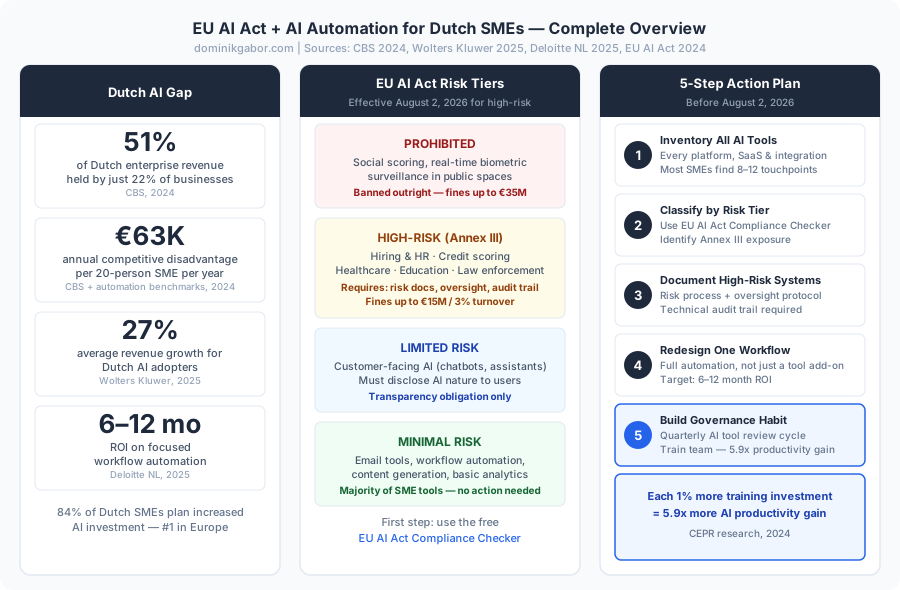
Save or share this, it is the full breakdown in one view.
Ready to Check Your AI Compliance Exposure and Find Where You're Leaving Revenue Behind?
Book a free 30-minute AI Readiness and Compliance Assessment. We'll review your current AI stack, work out whether the transparency rules now in force apply to any of it, flag anything heading for the December 2027 high-risk date, and map the three highest-ROI automation opportunities in your business. No sales pitch. Just clarity on where you stand.
Most Dutch SMEs discover at least one tool with unexpected compliance exposure, and three automatable workflows they've been handling manually for years.
Book Your Free AI Assessment Or start with the free AI workflow audit checklist →Share This Article
If this was useful, share it with a business owner who's running on manual processes and hasn't looked at the August 2026 deadline yet.

About Dominik Gabor
AI Automation Consultant based in the Netherlands, working with businesses worldwide. Dominik helps small and mid-size businesses implement AI Operating Systems, from lead response automation to strategic daily briefings. He tests 27+ AI tools daily and has built automation systems for businesses across Europe and the US.