
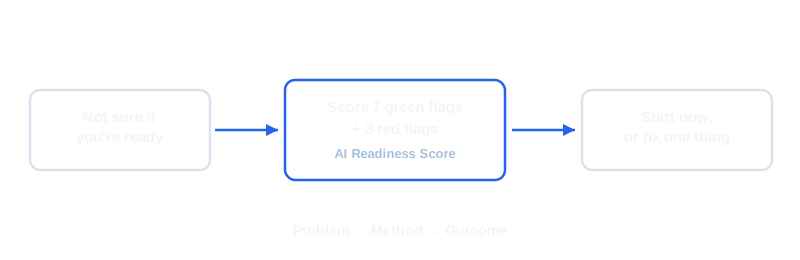
"Is my business ready for AI?" is the wrong question to lead with, and asking it too broadly usually delays the answer instead of finding it. The narrower, more useful question is: which specific process should you automate first, and do you already have what that process needs in place?
Dominik Gabor of TwinScale AI, an AI automation consultant in Leeuwarden who has spent 2+ years testing 27+ AI tools, keeps seeing the same pattern when business owners ask this question. The businesses that get real value from automation in the first few weeks nearly always share a small set of traits before they start. The ones that stall nearly always share a different, smaller set of traits too.
This post lays out both sets: the 7 green flags that suggest you're ready now, the 3 red flags that suggest you should wait, and a simple scoring framework you can run against your own business in about five minutes.
A business is ready for AI automation when it has at least one process that is repetitive, well understood, and already generating data or a paper trail, plus someone internally who can own the rollout and a rough idea of what success looks like. Readiness has little to do with company size, technical skill, or a large budget. It has almost everything to do with whether the process you want to automate is stable enough to automate in the first place.
Key Takeaways
- 7 green flags, 3 red flags: Most SMEs fall clearly into "start now" or "fix the process first" once they check both lists honestly.
- Readiness is not about size or budget: A 12-person business with one clean, repetitive process is more ready than a 200-person business where nobody agrees how the process works.
- The AI Readiness Score takes 5 minutes: A simple point system turns "maybe" into a specific next step.
- Waiting has a real cost, but so does starting too early: Automating an undocumented process usually automates the confusion, not the work.
- Most fixes take weeks, not months: Documenting one process is almost always faster than people expect.
Not Every Business Is Ready, and That's Worth Knowing Now
Being honest about readiness up front saves more time than it costs. A business that starts automating a process nobody has fully documented usually ends up automating the confusion, not the work. That is a worse outcome than spending a few weeks documenting the process properly before touching any tooling.
The good news is that readiness has nothing to do with company size or headcount. A 12-person company with one clean, repetitive process is more ready than a 200-person company where three departments each do the same task a different way and nobody agrees which version is correct.
The lists below follow the pattern that shows up again and again in those conversations: the same handful of green flags show up before a fast, successful rollout, and the same handful of red flags show up before a stalled one.
The 7 Green Flags: You're Probably Ready

1. You Have At Least 3 Repetitive Processes Eating 5+ Hours a Week
If you can name three tasks right now that follow the same steps every time, in every case, you already have automation candidates. Data entry, status update emails, weekly reporting, and invoice chasing are the most common starting points for SMEs. The test is not whether the task matters. It is whether it is the same steps, in the same order, with no judgment call required in the middle.
2. Your Team Complains About "Busy Work"
When employees describe part of their job as "busy work" or "the boring part," they are already doing your process audit for you. That complaint is a signal the task has little meaningful decision-making left in it, which is exactly the kind of work automation handles well.
3. You're Scaling But Can't Hire Fast Enough
Growing headcount to keep up with growing repetitive volume is slow and expensive. If your hiring plan exists mainly to cover more of the same manual work rather than genuinely new capability, automation usually closes that gap faster and cheaper than a new hire would.
4. You Have Data Sitting in Spreadsheets Nobody Analyzes
A spreadsheet that gets updated but never read is a strong readiness signal. It means the data collection habit already exists. The missing piece is turning that data into a report or an alert, which is a smaller lift than building data collection from scratch.
5. Your Competitors Are Already Using AI
Competitive pressure is not proof you need automation, but it is a sign the market has already decided the underlying process is automatable. Statistics Netherlands found that 22.7% of Dutch companies with 10 or more employees used at least one AI technology in 2024 (CBS, AI Monitor 2024). This shows up clearly in the Netherlands and Germany right now, where tight labor markets push automation from optional to necessary faster than in less constrained markets. Businesses evaluating this specific pressure can look at the Dutch SME AI adoption data for a regional view of where that pressure is heading.
6. You've Tried ChatGPT or Claude and Saw the Potential
Casual, unstructured use of ChatGPT or Claude is a common first step for business owners, and it is a genuine readiness signal, not a distraction. If you have already had the moment of thinking "this could handle more of my week," you have done the hardest part: believing it is possible before anyone proved it to you.
7. You Can Set Aside Around €1,000 for a First Automation
This is a deliberately small number. A process that eats 5 hours a week at €40 an hour costs about €10,000 a year to run by hand. One focused automation, built in a tool like n8n with an AI reasoning step, costs a fraction of that to set up. If you can fund one workflow as a test, you can find out whether automation works for your business before committing to anything larger.
The 3 Red Flags: Wait Before You Start
1. Your Core Processes Aren't Documented Yet
If the process only exists in someone's head, automating it means encoding one person's version of events, not the actual process. Write it down first, even roughly. Documentation is a few days of work. An automation built on an undocumented process is a rebuild waiting to happen.
2. You're in the Middle of a Major Restructuring
Automation works best on a process that will still look the same in six months. If your team, tools, or reporting lines are actively changing, wait until the dust settles. Building automation into a moving target means rebuilding it again once the target stops moving.
3. You Expect AI to Fix a Broken Business Model
Automation makes a working process faster and cheaper. It does not turn a business model that does not work into one that does. If the underlying problem is pricing, demand, or positioning rather than manual workload, automation will not solve it, and starting there usually just delays the real fix.
The AI Readiness Score: A 5-Minute Self-Assessment
Dominik Gabor, TwinScale AI, built this scoring framework because "maybe" is not a useful answer for a business owner deciding where to spend the next month. It converts the two lists above into a single number.
Add 1 point for each green flag that is true (max 7 points).
Subtract 2 points for each red flag that is true (max -6 points).

Score of 5 or higher: you're ready to start now.
Score of 2-4: pick one adjustment (usually documenting a process)
  before you start, then re-score.
Score below 2: focus on the red flags first. Revisit in a few weeks.
A worked example makes this concrete. Take a hypothetical 20-person manufacturer in Friesland that exports most of what it makes: three repetitive processes over 5 hours a week (+1), team complaints about busy work (+1), scaling faster than hiring (+1), unread spreadsheets (+1), competitors visibly using AI (+1), no ChatGPT use yet (0), and a €1,500 budget approved (+1). That's a score of 6, with no red flags present. This business would score as ready to start now, with the first candidate process being whichever of the three repetitive tasks has the clearest, most consistent steps.
Compare that to a hypothetical 15-person agency mid-way through a leadership change, with no documented processes and an expectation that "AI will fix our margins." Three red flags present means -6 points, and even 4 green flags only bring the total to -2. That business should resolve the restructuring and document at least one process before spending anything on automation.
What to Do If You're Ready

Start with the single process that scores highest on frequency and clarity, not the one that sounds most impressive. The goal of the first automation is proof, not scale. For a structured view of where to start, the complete guide to AI automation for SMEs walks through the layers most SMEs automate first, and 5 AI automations every business should set up in 2026 lists specific workflows with real setup steps.
If you would rather have someone map this out with you instead of guessing, a 30-minute conversation is usually faster than a few more weeks of research. That is also the moment to decide whether you build it yourself or bring in an AI consultant in the Netherlands. The guide to hiring an AI automation consultant covers the questions worth asking either way.
What to Do If You're Not Ready Yet
If your score landed below 2, the fix is almost always smaller than it feels. Documenting one process, even in a shared document with no formatting, is usually a matter of days, not months. Pick the process most people already agree on, write down every step as it actually happens today (not how it is supposed to happen), and re-run the score once that's done.
If a restructuring is the blocker, put automation on the calendar for after it settles rather than shelving the idea entirely. And if the honest answer is that AI would not fix the actual problem, that is useful information on its own. Knowing what automation will not do for you is as valuable as knowing what it will.
Frequently Asked Questions
How do I know if my business is ready for AI automation?
Your business is likely ready if you can name at least 3 repetitive processes eating 5 or more hours a week, your team already calls part of its job "busy work," and you can set aside around €1,000 for one first automation. Run the AI Readiness Score above: if you check 5 or more of the 7 green flags and none of the 3 red flags, you're ready to start now.
What is an AI readiness assessment?
An AI readiness assessment is a short check of whether a specific business process is stable, documented, and repetitive enough to automate, and whether someone internally can own the rollout. It is not a judgment of company size or technical skill. The AI Readiness Score in this post is a 5-minute version you can run yourself before spending anything.
What if my business isn't ready for AI automation yet?
If any of the 3 red flags apply, the fix usually comes before automation, not instead of it: document the process, finish the restructuring, or clarify the actual business problem first. Most businesses move from "not ready" to "ready" within a few weeks once the process itself is stable, not months.
How much does it cost to start automating a business process?
One focused automation, a single workflow built with n8n and an AI reasoning step, is the cheapest way to start. At TwinScale AI a Starter Build, one automation live in two weeks, starts at €1,000 excl. BTW, which is enough to test whether automation works for your specific process before committing to anything larger. The first step is a free 30-minute AI Profit Assessment.
The Bottom Line
Readiness is a property of the process, not the company. Score 5 or more of the 7 green flags with none of the 3 red flags present, and the honest answer is: start now, with the single clearest process first. Score below 2, and the honest answer is just as useful: fix one specific thing, usually documentation, then re-score in a few weeks.
The businesses that get this right are not the biggest ones or the most technical ones. They are the ones willing to answer the readiness question honestly before spending a euro on tooling.
The Complete Picture
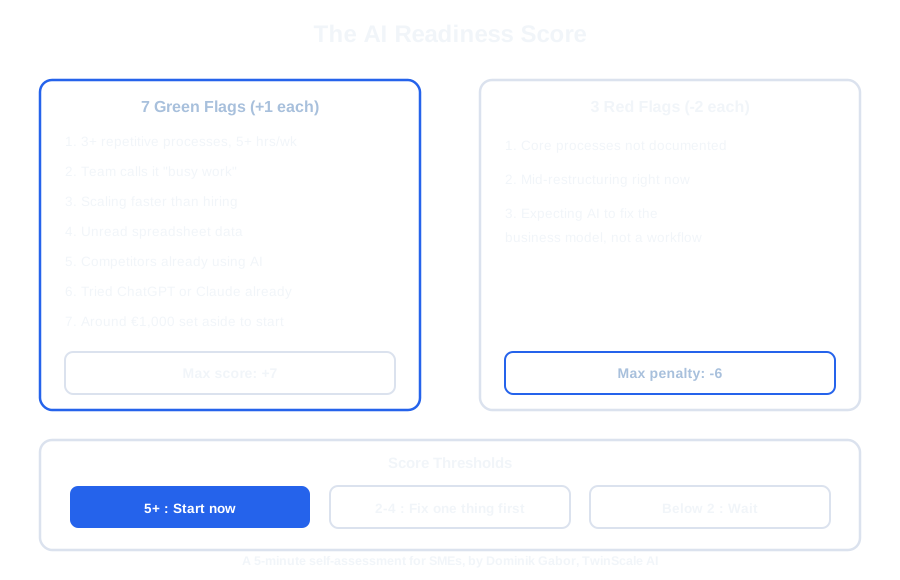
Save or share this, it's the full framework in one view.
Get your specific readiness answer in 30 minutes
The 7-and-3 checklist gets you close. A 30-minute conversation gets you specific: which process to automate first, what it will cost to set up, and what it will save every month once it's running.
- Which of your processes scores highest right now
- The one red flag worth fixing before you start
- A realistic setup timeline for your first automation
30 minutes. No obligation. No pitch unless you ask for one.
Or grab the free resources first →
About Dominik Gabor
AI Automation Consultant at TwinScale AI in Leeuwarden, the Netherlands. Dominik helps small and mid-size businesses figure out whether, and where, to start with AI automation, then builds the first workflow with them. He has spent 2+ years testing 27+ AI tools daily, and writes to give business owners the exact, practical starting points that most AI content skips over.