
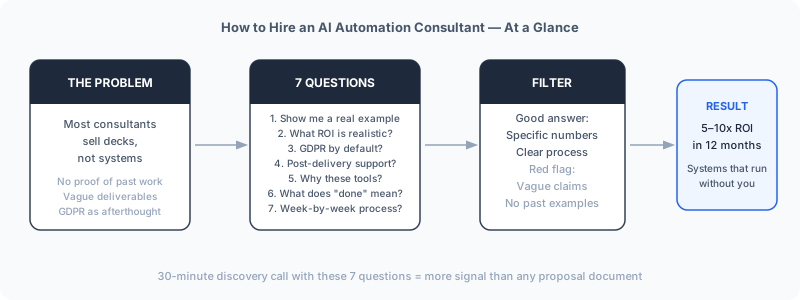
Most European SMEs that hired an AI consultant in 2025 didn't get burned by bad technology. They got burned by consultants who sold transformation and delivered slide decks. After two years working with AI tools daily and building automation systems, I've watched dozens of European businesses deal with the fallout from engagements that looked credible on paper and failed in execution. The warning signs were visible before the contract was signed. You just need to know which questions to ask.
Every SME I've worked with that avoided a costly consulting failure did one thing before signing: asked structured, specific questions. A 30-minute discovery call with the right checklist tells you more than a 60-page proposal.
An AI automation consultant analyzes your business workflows, identifies where AI tools can eliminate manual work or reduce errors, and builds or deploys those systems. They specialize in AI models, workflow automation platforms, and integration logic. Not general IT setup or software licensing. A good one leaves you with running systems and internal capability. A bad one leaves you with a roadmap and an invoice.
Why Most AI Consulting Engagements Underdeliver
The AI consulting market has expanded faster than at any point in the past decade. McKinsey's 2024 State of AI report found that 72% of organizations now use AI in at least one business function, up from 50% two years prior. That demand surge attracted a wave of self-declared experts who pivoted from digital marketing, IT sales, or project management with six weeks of ChatGPT experience. The technical bar to call yourself an AI consultant is effectively zero.
European SMEs are particularly exposed. Large enterprises have procurement teams and legal review processes. You probably don't. You're evaluating a consultant yourself, often under time pressure, with no internal AI expertise to sanity-check what you're being told.
The result: overpromised timelines, underdelivered systems, and invoices paid for work that never integrated into how your business runs.
The fix is straightforward. Seven questions. Ask them in your first call.
Want to know if your business is a fit for AI automation? Get in touch with me directly and we can map it out in 30 minutes.
The 7 Questions to Ask Any AI Automation Consultant Before You Sign
1. "Can you show me a specific automation you built? What did it actually save the client?"
This is the single highest-signal question you can ask. Not a case study PDF. Not a demo environment. A real workflow they built, for a real client, with a measurable outcome.
What you are looking for: specifics. "We automated invoice processing for a 40-person logistics company in Rotterdam: reduced processing time from 3 days to 4 hours, and eliminated 2 data entry errors per week that were causing client disputes." That is a real answer.
Red flag: "We have worked with companies in your industry on similar challenges." Vague, non-specific, and means nothing.
If they cannot point to one concrete example, they have not built enough to know what they are doing.

2. "How do you measure success, and what ROI is realistic for a business our size?"
Any consultant worth hiring has thought about this before the sales call. They should give you a range based on comparable engagements and be honest about timelines.
Reasonable expectations for a European SME: a well-scoped AI automation engagement should return 5 to 10 times the consulting fee within 12 months. Not immediately. Within 12 months. If they are promising 10x ROI in week one, walk away.
Also ask: "What is a situation where an engagement did not deliver the expected ROI?" A consultant who can answer this honestly is someone who has actually done the work. A good answer sounds like: "we built a workflow that was technically correct but the team never adopted it, so we revised the onboarding and ran adoption sessions."
3. "Are your solutions GDPR-compliant by default, or is compliance an add-on?"
For European SMEs, this is not optional. Workflows that process customer data, employee records, or any personally identifiable information are subject to GDPR. (If you are also navigating the EU AI Act, the compliance overlap is significant. See EU AI Act compliance for Netherlands SMEs.) A consultant who treats compliance as an afterthought creates legal exposure for your business.
The correct answer: compliance is built into the architecture from day one. Data does not leave the EU unless explicitly required. Retention policies, consent logging, and data minimization are standard, not extras.
Red flag: "We can review GDPR requirements after the build." That is the wrong order.
For Dutch and German SMEs especially, GDPR enforcement at the SME level is no longer theoretical. Regulators have issued fines for exactly this type of data handling, and a five-figure penalty is a real outcome for non-compliant workflows processing customer data.
4. "What happens after the project ends? Who maintains the system?"
This question separates project vendors from actual partners. Automation systems break. APIs change. Business processes evolve. A system running without updates for 12 months is rare. One that never needs maintenance does not exist.
Ask specifically: "Is post-delivery support included? At what cost? What is your typical response time when something breaks?"
What you want: clear documentation, a defined handover process, and an ongoing support option at known rates. What you do not want: "we will make sure it works before delivery" with no plan for what happens after.
The best consultants build with maintenance in mind: modular workflows, documented logic, and written runbooks your team can actually follow.
5. "What tools will you use, and why those specifically?"
The right answer depends on your situation, not on the consultant's preferred stack. A consultant who defaults to the same tools regardless of context is optimizing for their own efficiency, not yours.
Concrete example: n8n is the right choice for a business that wants control over data residency and plans to self-host. Make.com fits a team that needs an easier interface without a developer on staff. Zapier works for simple integrations with a limited budget. These are different tools for genuinely different situations.
Ask: "Given our current systems, team size, and budget, which tool would you use? And what would you use if our budget were half of what you are proposing?"
A consultant who can answer both versions of that question is thinking about your business.
6. "What does 'done' look like at the end of our engagement?"
Most failed consulting engagements fail at the definition-of-done stage. Scope creep, moving goalposts, and vague deliverables are how consultants protect their billable hours and how clients end up paying twice.
Get specifics in writing before you sign: "At the end of this engagement, you will have [list of specific deliverables]. The system will be live, tested against [defined criteria], and documented. Your team will be trained and able to run it without external support."
If the proposal does not include this level of clarity, ask for it. If they resist, that tells you everything you need to know.
7. "What is your process from week one to handover?"
You are not just evaluating the output: you are evaluating the relationship you are about to enter. A consultant with a clear, repeatable process has run this before and knows where the problems are.
A solid engagement looks something like: week 1 is discovery and workflow mapping. Weeks 2-3 are build and iteration. Week 4 is testing, documentation, and team handover. Week 5 is go-live with a support buffer. The exact timeline varies. But the structure should be clear.
If they cannot describe their process in under 5 minutes, they do not have one.
If you want to run this evaluation with a specific business situation in mind, book a free AI Profit Assessment: 30 minutes, no cost, and I will map where automation fits for your operation.
What Good Engagements Actually Look Like

Working with European SMEs across the Netherlands, Germany, and Belgium on AI automation systems, there is a consistent pattern in which engagements succeed. The businesses that get 5 to 10x ROI on AI automation always do three things before signing: they ask for a specific past example, they define success criteria in writing, and they confirm post-delivery support.
The engagements that fail almost always break down in the same place: discovery. A consultant who skips proper workflow mapping and jumps straight to building will eventually hit a wall, a data structure that doesn't export correctly, a process that the team doesn't actually follow, an integration that looked simple on paper. By the time that happens, weeks and significant budget are already spent.
The engagements that succeed start differently. The first week is entirely discovery: understanding the existing workflow, identifying where the real friction is, mapping data sources before writing a single line of automation logic. That groundwork is what makes the build phase fast and the result usable.
The difference is not the tools. It is the process.
After two years working with AI tools daily and building automation systems across dozens of engagements, the single most reliable predictor of a good outcome is whether the client asked hard questions before signing. The ones who did got systems that ran. The ones who didn't got decks.
The AI Automation Consultant Hiring Checklist
Save this before your next discovery call.
- Request a real example: specific workflow, specific client type, specific outcome (time saved, errors eliminated, cost reduced)
- Get ROI benchmarks: ask for realistic 12-month expectations based on comparable engagements, not best-case projections
- Confirm GDPR compliance: it should be architectural, not an afterthought; ask explicitly whether data stays within the EU
- Clarify post-delivery support: documentation, team training, and maintenance terms in writing before signing
- Challenge the tool choice: ask why those tools for your specific situation, not just the consultant's default stack
- Define done in writing: specific deliverables, go-live criteria, and team handover included in the contract
- Evaluate the process: a clear week-by-week structure signals experience; vagueness signals risk
Browse workflow frameworks and AI implementation templates on the free resources page.
Frequently Asked Questions
What questions should I ask an AI automation consultant before hiring?
The 7 most important: Can you show me a specific automation you built and what it saved the client? What ROI is realistic for my business size? Are your solutions GDPR-compliant by default? What is the post-delivery support structure? Why those specific tools for my situation? What does "done" mean in contract terms? What does your week-by-week process look like? Asking all 7 in a first call takes under 30 minutes and surfaces more information than any proposal document.
How much does AI automation consulting cost for European SMEs?
Most consultants start with a free or low-cost assessment. A first project, one automation live in a few weeks, typically starts around €1,000. Larger systems are priced per project, ideally with a fixed price agreed before work starts. Most SMEs see full ROI within 6–12 months on well-scoped projects.
What ROI should I expect from an AI automation consultant?
For a well-scoped engagement, 5 to 10 times the consulting fee within 12 months is a realistic benchmark. That typically means 200–500 staff hours saved per year, 1–3 manual processes eliminated entirely, and 30–60% reduction in error rates on the automated workflows. Agree on these numbers before signing. A consultant who cannot estimate them upfront has not run this engagement before.
What are red flags when hiring an AI automation consultant?
Vague case studies without specific numbers. GDPR compliance treated as optional or an add-on cost. No clear process from week one to handover. Resistance to defining deliverables in writing before signing. Only one tool recommendation regardless of your context. Promises of immediate ROI. Any of these warrant harder follow-up questions or walking away from the engagement.
Should I hire a freelance AI consultant or a consulting firm for my SME?
For most European SMEs, a specialist boutique with 1–5 people and deep automation expertise outperforms both solo freelancers and large firms. Freelancers carry availability and continuity risk. Large firms add overhead and often assign junior staff to SME accounts. A boutique with a clear track record, defined process, and direct access to the person who will build your system is the right fit for most SME engagements.
The Bottom Line
Most bad AI consulting engagements were preventable. Consultants who underdeliver reveal themselves in the first 30 minutes if you ask the right questions. The 7 questions in this post separate consultants who have built real systems from consultants who have built good proposals.
Hiring an AI automation consultant is a meaningful investment for any European SME. Done right, it returns 5 to 10 times its cost in 12 months and frees your team from processes that should not need human attention. Done wrong, it burns budget and erodes trust in AI adoption across your organization.
Ask the 7 questions. Demand specifics. Get deliverables in writing before you sign. The right consultant will welcome the scrutiny.
The Complete Picture
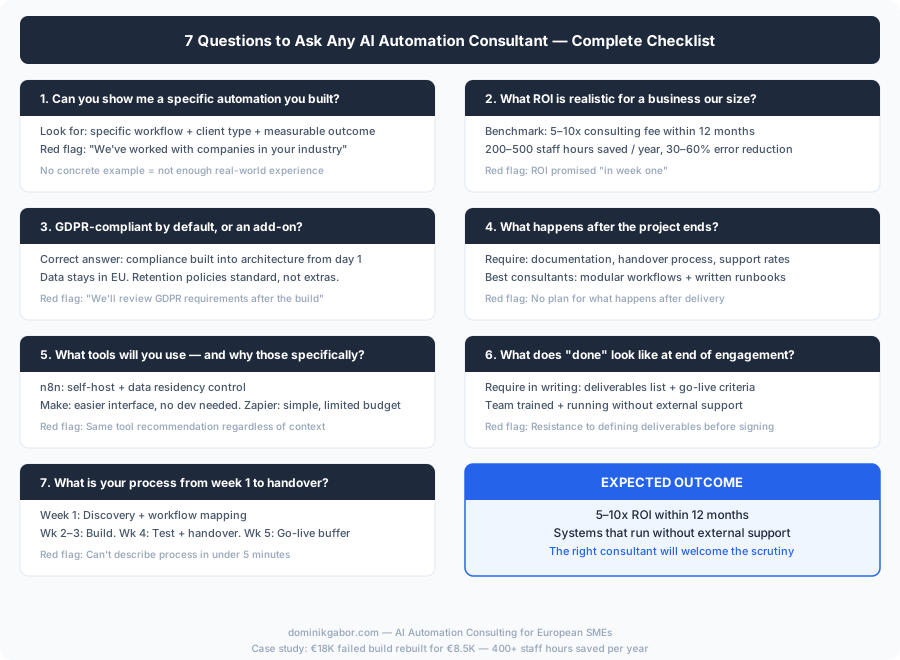
Save or share this: the full breakdown in one view.
Ready to Find Out What Your Team Can Stop Doing by Next Quarter?
Book a free 30-minute AI Profit Assessment. I'll map the highest-impact automation opportunities in your specific workflows and give you a concrete implementation plan with realistic ROI estimates.
Most business owners are surprised by how much of their week is automatable once we map it out together. No pitch, no commitment.
Book Your Free AI Profit Assessment Or start with the free resources and workflow frameworks →Share This Article
If this was useful, share it with a business owner who's about to sign with an AI consultant without asking the right questions first.

About Dominik Gabor
AI Automation Consultant at TwinScale AI in Leeuwarden, the Netherlands. Dominik helps small and mid-size businesses implement AI Operating Systems, from lead response automation to strategic daily briefings. He tests 27+ AI tools daily.