
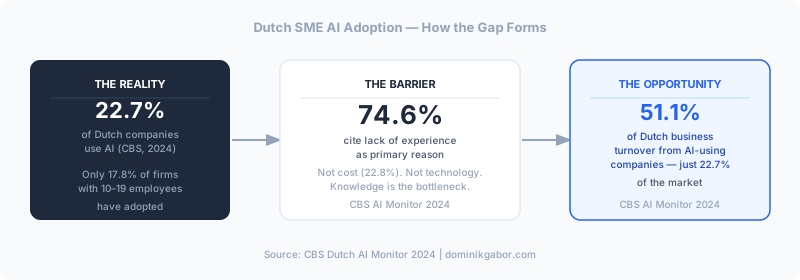
More than one in five Dutch companies with at least ten employees used artificial intelligence in 2024. That figure, 22.7%, published by Statistics Netherlands in February 2025, represents the steepest single-year increase in Dutch AI adoption history: nearly nine percentage points gained in twelve months (Statistics Netherlands [CBS], 2025, February 27). Dominik Gabor, an AI automation consultant based in the Netherlands, works with European SMEs to close exactly this gap between businesses watching these numbers climb and those actually moving. The data tells a clear story: adoption is accelerating, but it is not evenly distributed. Where your business sits on that curve determines what competitive pressure looks like over the next two years.
Dutch SME AI adoption refers to the share of small and medium-sized enterprises in the Netherlands (up to 250 employees, following the EU definition) that actively use at least one artificial intelligence technology in their business operations. The primary official measure comes from the annual CBS Dutch AI Monitor, which surveys companies with 10 or more employees.
How Many Dutch Businesses Are Actually Using AI?
The headline number from the CBS Dutch AI Monitor 2024 is 22.7%. But what matters is what sits underneath it.
That figure covers all companies with 10 or more employees. It jumped from 14.0% in 2023, after a slight dip from 15.8% in 2022. The trend since 2021 (13.1%) shows steady but unspectacular growth until 2024, when the arrival of mainstream generative AI tools produced the sharpest year-on-year shift in the dataset (CBS, 2025, February 27).
Year-on-year trend
The year-on-year trend (CBS AI Monitor 2024):
| Year | AI Adoption Rate (companies, 10+ employees) |
|---|---|
| 2021 | 13.1% |
| 2022 | 15.8% |
| 2023 | 14.0% |
| 2024 | 22.7% (provisional) |
Source: Statistics Netherlands (CBS). (2025, February 27). Dutch AI monitor 2024.
But the most revealing data is by company size. Adoption is not evenly spread across the SME category.

Adoption by company size
AI adoption by company size, Netherlands, 2024:
| Company Size (employees) | AI Adoption Rate |
|---|---|
| 10–19 | 17.8% |
| 20–49 | 22.2% |
| 50–99 | 28.1% |
| 100–249 | 34.8% |
| 250–499 | 46.2% |
| 500+ | 59.2% |
Source: Statistics Netherlands (CBS). (2025, February 27). Dutch AI monitor 2024, Section 2.
The smallest firms in this dataset sit at 17.8%. The largest are at 59.2%. That is not a gap. It is a structural divide. For Dutch SMEs with fewer than 50 employees, roughly four in five are still operating without AI in any measurable form.
A subsequent CBS release from December 2025, which used a wider sample base (companies with 2+ employees), confirmed that growth continued through 2025:
AI adoption growth including micro-businesses, 2023–2025:
| Company Size | 2023 | 2024 | 2025 |
|---|---|---|---|
| 2–9 employees | 7% | 11% | 14% |
| 10–49 employees | 11% | 19% | 27% |
| 50–249 employees | 20% | 31% | 45% |
| 250+ employees | 42% | 53% | 66% |
Source: Statistics Netherlands (CBS). (2025, December 12). Companies using AI above all for marketing or sales.
Important methodological note: The December 2025 release uses a broader sample (2+ employees vs. 10+ in the AI Monitor) and is not directly comparable to the 2021–2024 series. Both are valid measures of different population segments.
Perhaps the most striking figure in the entire CBS dataset is this: companies using AI represented 51.1% of total Dutch business turnover in 2024, despite comprising just 22.7% of all companies (CBS, 2025, February 27). That concentration tells you where the competitive pressure is coming from. AI-adopting firms are, on average, generating significantly more revenue than their non-adopting peers. The gap is widening.
Which Sectors Are Leading and Which Are Being Left Behind?
Sector matters as much as size. If you are in ICT or financial services, you are in a sector where AI adoption is already a competitive baseline. If you are in construction or food and accommodation, you are in a very different reality.
AI adoption by sector, Netherlands, 2024:
| Sector | Adoption Rate |
|---|---|
| Information & Communication | 58.0% |
| Specialized Business Services | 39.8% |
| Financial Services | 37.4% |
| Real Estate | 28.0% |
| Trade | 23.2% |
| Health & Social Work | 18.4% |
| Manufacturing | 18.0% |
| Transportation & Storage | 11.0% |
| Food & Accommodation | 9.0% |
| Construction | 8.9% |
Source: Statistics Netherlands (CBS). (2025, February 27). Dutch AI monitor 2024, Section 2.
The spread from 8.9% (construction) to 58.0% (ICT) reflects the extent to which AI adoption has been led by knowledge-intensive and data-rich industries. Manufacturing sits at 18.0%, just above the overall average for small firms, which suggests meaningful headroom, particularly in process automation and quality control applications.
If your sector appears low on this table, that cuts both ways. You face less competitive pressure from AI-adopting rivals right now. But you also have less time than you think before the laggards catch up to where the ICT sector was three years ago.
What Are Dutch Companies Actually Doing With AI?
Knowing the adoption rate is one thing. Knowing what companies are doing with it and how they got it. That shapes the practical decisions you face.
Most-used AI technologies
Most-used AI technologies, Dutch companies with 10+ employees, 2024:
| AI Technology | 2024 Adoption | 2023 Adoption | Change |
|---|---|---|---|
| Text mining | 13.5% | 5.3% | +155% |
| Natural language generation | 12.3% | 4.2% | +193% |
| Speech recognition | 6.5% | 3.7% | +76% |
| Machine learning | 6.3% | - | - |
| Image recognition | 4.5% | - | - |
Source: Statistics Netherlands (CBS). (2025, February 27). Dutch AI monitor 2024, Section 2.
Natural language generation (the category that includes tools like ChatGPT) nearly tripled in adoption in a single year. Text mining nearly tripled too. These are the tools that require the least technical infrastructure to deploy, which explains the spike.

Primary use cases
Primary AI use cases among AI-using Dutch companies, 2024:
| Use Case | % of AI-using companies |
|---|---|
| Marketing & Sales | 36.4% |
| Admin / Management | 30.3% |
| Research & Development | 25.6% |
| Accounting / Finance | 22.9% |
| ICT Security | 21.0% |
| Production Processes | 19.6% |
| Logistics | 6.5% |
Source: Statistics Netherlands (CBS). (2025, February 27). Dutch AI monitor 2024, Section 2.
Marketing and sales leads, mostly because text generation tools plug directly into existing workflows without requiring system integration. Back-office and finance use cases follow. Production and logistics, which typically require deeper integration with operational systems, remain underexploited.
How Dutch companies acquire AI
| Method | % of AI-using companies |
|---|---|
| Commercial software (unmodified) | 55.6% |
| External suppliers | 27.6% |
| Commercial software (adapted) | 25.2% |
| Open-source (adapted) | 24.1% |
| In-house development | 19.5% |
Source: Statistics Netherlands (CBS). (2025, February 27). Dutch AI monitor 2024, Section 2.
More than half of AI-using Dutch companies are using off-the-shelf commercial software with no customisation or integration. That is the fastest path to adoption, and also the path most likely to produce generic results. The 27.6% working with external suppliers are getting more tailored implementations. The 19.5% building in-house are further along the maturity curve.
If you want to see where your business sits on this curve and what the next realistic step looks like, book a free AI Profit Assessment. 30 minutes, no pitch, just a clear picture of your current state.
How Does the Netherlands Compare to the Rest of Europe?
The Netherlands looks strong in the EU context. But "strong" is relative.
In 2024, the Netherlands ranked 6th in the EU for enterprise AI adoption at 23.1% (10+ employees). The EU-27 average was 13.5%, making the Dutch figure nearly double the EU mean (CBS, 2025, February 27; Eurostat, 2024).
EU AI adoption leaders, 2024:
| Country | AI Adoption Rate |
|---|---|
| Denmark | 27.6% |
| Sweden | 25.1% |
| Belgium | 24.7% |
| Finland | 24.4% |
| Luxembourg | 23.7% |
| Netherlands | 23.1% |
| EU-27 average | 13.5% |
Source: Statistics Netherlands (CBS). (2025, February 27). Dutch AI monitor 2024, Summary; Eurostat. (2024). ICT usage in enterprises.
By 2025, the EU-wide figure had risen to 20.0% of enterprises, a 6.5 percentage point increase from 2024. EU leaders in 2025: Denmark (42.0%), Finland (37.8%), Sweden (35.0%) (Eurostat, 2025, December 11).
At the EU level, the size breakdown for 2025 shows the same pattern as the Dutch data:
| Enterprise Size | EU AI Adoption (2025) |
|---|---|
| Large (250+ employees) | 55.0% |
| Medium (50–249) | 30.4% |
| Small (10–49) | 17.0% |
Source: Eurostat. (2025). Use of artificial intelligence in enterprises.
The sector breakdown at EU level also mirrors the Dutch picture: ICT leads (62.5%), construction trails (10.8%) (Eurostat, 2025).
One important structural challenge: the European Commission's 2025 Netherlands Digital Decade Country Report directly flags that "smaller Dutch enterprises often lag in adopting key digital technologies, especially AI," pointing to fragmented, region-driven innovation structures. The Commission specifically recommends the Netherlands "strategically allocate public and private resources to support SMEs' adoption of digital technologies, in particular AI" (European Commission, 2025).
This is not an abstract policy concern. It means EU funding and support programmes for SME digitalisation are specifically targeting Dutch companies that are not yet using AI.
The EU's broader Digital Decade policy targets 90% of SMEs reaching at least a basic level of digital intensity by 2030. As of 2024, 73% of EU SMEs had cleared that baseline, still 17 percentage points short of the 2030 target (Eurostat, 2024, August 29).
Update, January 2026: The OECD's most recent cross-country data confirms the same trajectory at a wider scale. Firm-level AI adoption across OECD countries more than doubled in two years, from 8.7% in 2023 to 20.2% in 2025 (OECD, 2026, January). The size gap the CBS data shows for the Netherlands holds across the whole bloc: EU-wide, 55% of large enterprises (250+ employees) used AI in 2025, compared to just 17% of small enterprises (10-49 employees), a 38 percentage point gap (Eurostat, 2025, December 11). The Dutch pattern is not a local anomaly. It is the European default, and the Netherlands is simply further along the same curve than most.
Why Are So Many Dutch SMEs Still on the Sidelines?
The barrier data from CBS is the most actionable section of the entire AI Monitor. It answers the question directly: why haven't the other 77% adopted AI?
Barriers cited by Dutch companies that considered but did not adopt AI, 2024:
| Barrier | % citing this reason |
|---|---|
| Lack of experience | 74.6% |
| Privacy concerns | 44.0% |
| Legal consequences | 37.4% |
| Difficult to obtain | 37.0% |
| Incompatibility with existing systems | 34.8% |
| Costs too high | 22.8% |
| Ethical reasons | 20.5% |
Source: Statistics Netherlands (CBS). (2025, February 27). Dutch AI monitor 2024, Section 2.
Nearly three in four non-adopters point to the same reason: they simply do not know enough to get started. That dwarfs every other concern. Cost, the barrier most people assume is primary, sits at 22.8%. Legal uncertainty (37.4%) and privacy (44.0%) are real concerns but secondary.
This is not a technology problem. It is a knowledge and confidence problem.
The EU-level barrier data (Eurostat, 2025) confirms the pattern: 70.9% of non-adopting enterprises cite lack of expertise, 52.5% cite legal uncertainty, 48.8% cite data protection concerns.
The compliance picture adds a further complication. A June 2025 survey by KvK (the Dutch Chamber of Commerce), covering 651 Dutch entrepreneurs, found:
- 50% were entirely unaware of the EU AI Act
- Only 7% considered themselves well-informed about the regulation
- 40% were uncertain whether the law applied to their business
- Only 2–3% were actively preparing for compliance
- 30% were already using generative AI tools like ChatGPT or Microsoft Copilot in daily operations
(KvK, 2025, September 11)
The gap between usage and regulatory readiness is real and widening. Thirty percent of Dutch SMEs are already using generative AI. Most of them do not know what compliance obligations that creates. For a deeper look at what the EU AI Act means in practice, see the EU AI Act compliance guide for Dutch SMEs.
The Ambition Gap: What Dutch SMEs Plan to Do Next
Current adoption numbers and future intentions point in very different directions. That gap is itself a data point.
A March 2026 survey by Wolters Kluwer covering more than 1,000 SMEs across eight European countries found that 84% of Dutch SMEs planned to increase AI investment over the next three years, the highest proportion of any country surveyed, including Germany, the UK, Sweden, Denmark, Belgium, Italy, and Spain (Wolters Kluwer, 2026, March 17).
The same survey found that Dutch SMEs have built meaningful infrastructure for this:
- 81% use cloud services (31% fully cloud, 50% hybrid)
- 54% have strengthened cybersecurity in the past three years
- 90% are confident about their company's future
(Wolters Kluwer, 2026, March 17)
The top operational challenge for Dutch SMEs was talent acquisition and retention at 41%, significantly above economic conditions (31%), which in comparison ranked far higher in Sweden (55%) and the UK (56%).
That talent pressure is directly relevant to AI adoption. The companies that move fastest on AI are often doing so precisely because they cannot hire fast enough to scale manually.
Dutch SME leaders believe in AI's value. The CBS data shows that fewer than one in four have implemented it in any measurable form. The Wolters Kluwer data shows that 84% intend to change that. The bottleneck is not ambition. It is the knowledge, process, and confidence to execute.
What This Means for Your Business
The data points to three actionable conclusions for Dutch SMEs in 2026.
1. The window for first-mover advantage is still open. It is narrow.
At 17.8–22.2% adoption among SMEs with 10–50 employees, most of your direct competitors are not using AI in production yet. That changes. The 2024 spike suggests the diffusion curve is now in its steepest phase.
2. The knowledge gap is the real barrier, not budget.
74.6% of non-adopters cite lack of experience, not cost, as their primary reason (CBS, 2025). The practical implication: the fastest path forward is not buying more software. It is getting clear on where AI fits in your specific workflows before purchasing anything.
3. Compliance is not a future problem.
If 30% of Dutch SMEs are already using tools like ChatGPT and fewer than 3% are preparing for EU AI Act compliance (KvK, 2025), the risk is already present. Compliance planning needs to run alongside adoption, not after.
Your next step depends on where you are:
- Not yet using AI: Start with a structured assessment of your highest-leverage processes. That is where the CBS data shows the biggest adoption and ROI (marketing/sales, admin, finance).
- Experimenting with AI tools: The jump from 17.8% to 59.2% adoption by company size shows that the firms pulling ahead are integrating AI into core operations, not just using it for one-off tasks.
- Using AI in operations: The revenue concentration finding (51.1% of Dutch business turnover from AI-using companies) suggests the performance gap between adopters and non-adopters is already compounding. The next stage is building repeatable systems, not just using tools.
For a practical starting point, the free AI tools and prompt library covers the core frameworks Dominik uses with European SME clients.
Frequently Asked Questions
What percentage of Dutch SMEs use AI in 2026?
According to Statistics Netherlands (CBS), 22.7% of Dutch companies with 10 or more employees used at least one AI technology in 2024, up from 14.0% in 2023. Among the smallest firms (10–19 employees), the rate was 17.8%. A subsequent CBS release covering 2025 (using a wider base of 2+ employees) showed continued growth: 27% for the 10–49 employee band (CBS, 2025, December 12).
Why are Dutch companies slow to adopt AI?
The primary barrier is not cost or technology. It is knowledge. In the CBS AI Monitor 2024, 74.6% of Dutch companies that considered but did not adopt AI cited lack of experience as the main reason. Privacy concerns (44.0%) and uncertainty about legal consequences (37.4%) followed at a significant distance (CBS, 2025, February 27).
How does the Netherlands compare to the EU on AI adoption?
The Netherlands ranked 6th in the EU for enterprise AI adoption in 2024 at 23.1%, well above the EU-27 average of 13.5%. Five countries outperformed the Netherlands: Denmark (27.6%), Sweden (25.1%), Belgium (24.7%), Finland (24.4%), and Luxembourg (23.7%). By 2025, the EU average had risen to 20.0%, with Denmark reaching 42.0% (CBS, 2025; Eurostat, 2025, December 11).
What AI tools are Dutch businesses using most?
Text mining (13.5% of all Dutch companies with 10+ employees) and natural language generation tools (12.3%) were the most widely adopted AI technologies in 2024, both more than doubling from 2023 levels. The primary use case was marketing and sales (36.4% of AI-using companies), followed by administration and management (30.3%) (CBS, 2025, February 27).
What is the EU AI Act and how does it affect Dutch SMEs?
The EU AI Act is the world's first comprehensive AI regulation, which entered into force in 2024. A June 2025 KvK survey of 651 Dutch entrepreneurs found that 50% were entirely unaware of the law, only 7% considered themselves well-informed, and just 2.3% were actively preparing for compliance even though 30% were already using generative AI tools like ChatGPT or Microsoft Copilot in their daily operations (KvK, 2025, September 11).
The Bottom Line
The Netherlands is ahead of the EU average on AI adoption. The gap between the smallest SMEs and larger firms is stark, and the knowledge barrier (not cost) is what is keeping most businesses on the sidelines. The firms that close that gap in the next 12–18 months will benefit from a compounding advantage that the CBS revenue concentration data is already beginning to show.
The 22.7% headline figure is real. So is the 51.1% revenue share that AI-using companies already hold. The question for every Dutch SME owner is not whether AI adoption matters. The question is whether you will be in the 22.7% driving it or the 77.3% watching it happen.
The data shows the window is open. It also shows it is closing faster than most business owners expect.
Ready to find out where your business sits on the Dutch AI adoption curve? Book a free AI Profit Assessment. 30 minutes and you will leave with a clear picture of where AI fits in your specific operations and what the next practical step looks like.
References
European Commission. (2025). The Netherlands 2025 Digital Decade country report. https://digital-strategy.ec.europa.eu
Eurostat. (2024, August 29). How digitalised have the EU's enterprises become? Eurostat News. https://ec.europa.eu/eurostat
Eurostat. (2025). Use of artificial intelligence in enterprises. European Commission. https://ec.europa.eu/eurostat
Eurostat. (2025, December 11). 20% of EU enterprises use AI technologies. Eurostat News. https://ec.europa.eu/eurostat
KvK (Kamer van Koophandel). (2025, September 11). KVK research: Entrepreneurs take little action to comply with AI legislation. KvK Press. https://www.kvk.nl
OECD. (2026, January). AI use by individuals surges across the OECD as adoption by firms continues to expand. OECD News. https://www.oecd.org
Statistics Netherlands (CBS). (2025, February 27). Dutch AI monitor 2024. https://www.cbs.nl
Statistics Netherlands (CBS). (2025, February 27). Dutch AI monitor 2024 (Section 2: Use of AI technology by Dutch companies). https://www.cbs.nl
Statistics Netherlands (CBS). (2025, December 12). Companies using AI above all for marketing or sales. CBS News. https://www.cbs.nl
Wolters Kluwer. (2026, March 17). Dutch SMEs are leading the way in Europe in terms of AI ambitions and cloud infrastructure. Wolters Kluwer News. https://www.wolterskluwer.com
The Complete Picture
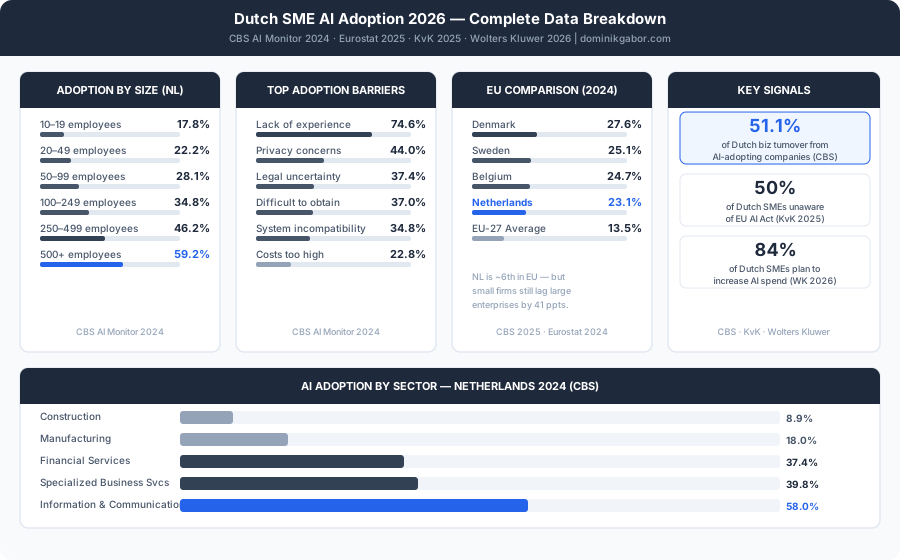
Save or share this. Full breakdown in one view.
Is Your Business in the 22.7%? Or Watching From the Sidelines?
74.6% of Dutch SMEs that looked at AI and didn't adopt cited lack of experience as the reason. A free 30-minute AI Profit Assessment maps your specific workflows against the CBS use case data and tells you exactly where AI can save your team time and money.
Most business owners are surprised by how much of their week is automatable once we map it out together.
Book Your Free AI Profit Assessment Or start with the free AI workflow audit checklist →Share This Article
If this was useful, share it with a business owner who's still running everything manually.

About Dominik Gabor
AI Automation Consultant at TwinScale AI in Leeuwarden, the Netherlands. Dominik helps small and mid-size businesses implement AI Operating Systems, from lead response automation to strategic daily briefings. He tests 27+ AI tools daily.