
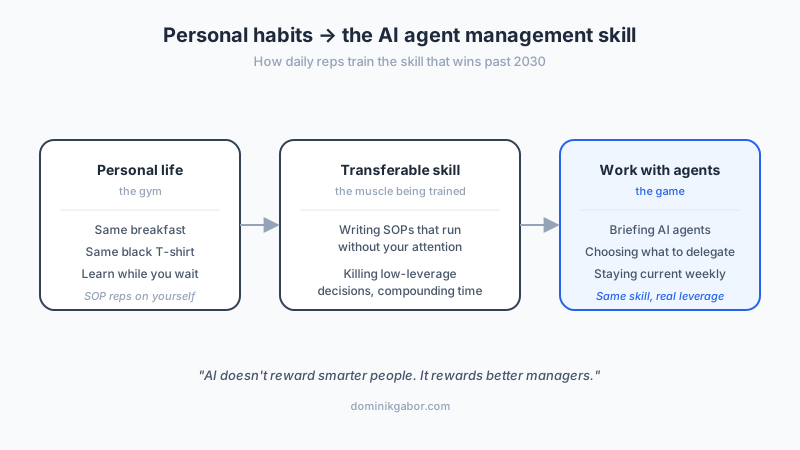
In five years most knowledge workers will manage AI agents instead of humans. The shift is already starting. Microsoft's 2025 Work Trend Index reports that 81% of leaders expect AI agents to be part of their company strategy within 12 to 18 months, and 32% say they are actively hiring AI agent specialists right now. The people who win in that shift will not be the smartest in the room. They will be the best managers in the room.
AI doesn't reward smarter people. It rewards better managers.
That is a problem for most ambitious people, because intelligence is the moat they have spent their whole career building. Dominik Gabor, an AI automation consultant based in the Netherlands, sees this every week with founders and operations directors at European SMEs. The smartest person on the call is rarely the one with the cleanest workflow. The one with the cleanest workflow is the one who already thinks in procedures, whether they call them that or not.
The fastest way to show what that skill looks like is to show it in everyday form. The examples below are concrete illustrations of the same skill that, applied at work, becomes managing AI agents.
Managing AI agents skills is the practice of writing clear briefs, eliminating low-leverage decisions, and supervising automated execution so an AI agent can run a task end to end. It is the new core skill of knowledge work in 2026 because most repeatable digital tasks are moving from human inboxes to agent runtimes.
What Managing AI Agents Actually Means in 2026
An AI agent is not a chatbot. It is a system that takes a brief, picks tools, performs a sequence of steps, checks its own output, and reports back. If you want a deeper definition, here is what an AI agent actually is. For this post the only thing you need to hold is that an agent runs on a written brief that you produce.
That single fact reshapes your job. Your value stops being how fast you can do a task. Your value becomes how well you can describe a task so something else can do it. Across the Netherlands and the wider EU we are seeing this shift land first in operations, marketing, and finance functions inside SMEs of 50 to 500 people. The companies that adopt fastest are the ones whose leaders already think in procedures.
This post is not about which tool to buy. It is about the skill underneath the tools, and how to train it before you need it.
The Real Skill AI Doesn't Teach You
If you are reading this you are probably smart. That is not a disadvantage. It is just no longer the moat.
The moat is procedural thinking. The ability to look at a task you do every week and ask: what is the smallest set of inputs and steps that produces the right output every time. That is the same question an AI agent runs on. People who already think this way at work will pick up agent management in weeks. People who do not will spend years confused about why their tools never quite save them time.
The skill that wins is procedural thinking, not raw intelligence.
The cleanest way to show what procedural thinking looks like is to point at it in places nobody usually looks. Most people only see procedures at work. The same shape shows up in private life too, just smaller and lower stakes. The next three sections show the skill in three of those places. The point is the shape of the skill, not the specific habit.
Trait #1: Same Breakfast (or Why a SOP Looks Boring on Purpose)

I eat roughly the same breakfast most days. Oats, eggs, fruit. Same time, same plates, no thought. The reason it earns a section in a post about AI is that it is the cleanest possible everyday illustration of what a SOP actually is.
The recipe is short. The inputs are fixed. The steps are repeatable. Any twelve-year-old could follow the same instructions and produce the same plate. That is what a written procedure looks like at its smallest scale.
That is also exactly what a brief for an AI agent looks like. Inputs, steps, output. Nothing else.
The skill underneath both of those is the same: the ability to take something fuzzy and write it down clearly enough that the result no longer depends on who is doing it. Most knowledge workers have never written a real SOP for anything in their life. McKinsey's 2025 State of AI report shows 62% of organisations are now experimenting with AI agents and 23% are scaling them in production. Microsoft's 2025 Work Trend Index adds that 81% of leaders expect agents inside their company strategy within 12 to 18 months. The companies pulling ahead in those numbers are not the ones with the most expensive tools. They are the ones whose people can write a one-page procedure without flinching.
A breakfast recipe and an AI agent brief have the same shape. Inputs, steps, output.
The breakfast is just where the shape is most obvious. The brief at work is where the same shape produces leverage.
Trait #2: Same Black T-Shirt (or Why Some Decisions Should Be Killed, Not Made)

I wear the same plain black T-shirt 95% of days. Not because I cannot afford another one. Because deciding what to wear has zero return on the rest of my year. It is the same skill at work in a tiny domestic decision: recognising a choice that does not compound and refusing to spend brain on it.
Knowledge workers toggle between apps and tabs roughly 1,200 times per day, and lose up to 40% of their productive time to context-switching according to research summarised in HBR. The American Psychological Association's economic-cost work puts the annual price of that switching at around $450B in the US alone. Asana's 2026 Anatomy of Work Index puts a finer number on the same problem: knowledge workers spend roughly 60% of their time on what Asana calls "work about work," which adds up to about 5 working weeks per year, per person, lost to coordination instead of output.
That is the work version of the same problem the wardrobe shows in miniature: hundreds of small decisions per day, very few of which compound. The skill is the ability to look at a stream of decisions and ask, before deciding, whether each one is worth a real choice or whether the right move is to kill it, default it, or hand it to something else.
The skill is recognising decisions that don't compound, and refusing to spend brain on them.
At work, that same skill is how you choose which tasks belong on your desk and which belong inside an AI agent. Repeatable, low-judgement, high-volume work has the same profile as a wardrobe decision. It does not deserve your brain. Tasks where your taste, your relationships, or your reputation are on the line are different. Those still need a human in the seat.
The T-shirt is just an obvious place to see the skill. The real return shows up later, in the choices you make about what to delegate to an agent and what to keep.
Trait #3: Learn While You Wait (or Why Dead Time Is Where the Skill Compounds)
Most people treat their day as work blocks plus dead time. I treat dead time as a third category: micro-learning. I watch three-minute videos about AI in the cracks of my day. Almost always on my phone. Almost always at 1.5 to 2x speed.
The skill is recognising that micro-time is leverage. It looks like nothing. It compounds into something serious. The math below is just one way to make that visible.
| Slot | Typical duration |
|---|---|
| Morning bathroom routine | ~12 min |
| Taxi or commute window | ~8 min |
| Gym between sets | ~30 min |
| Cooking | ~30 min |
| Eating alone | ~20 min |
| Walking | ~20 min |
| Total | ~2 hrs/day |
Two hours per day. Five days a week. Forty-eight weeks a year. That is roughly 480 hours per year of dead time that already exists in a normal adult life. At three-minute videos that is about 9,600 short lessons available without booking a single calendar block.
Micro-time looks like nothing. Compounded across years, in a field this fast, it is leverage.
The skill being illustrated here is not "watch more videos." It is the harder thing underneath: noticing that leverage often hides inside small, ignored intervals. At work, the same skill is what lets some people stay current with AI when the field updates every week, while others wait for a quarterly training day that never arrives. A release note read in line at the coffee shop. An n8n walkthrough between meetings. A paper summary skimmed while waiting for a build. None of it heroic, all of it compounding.
The Asana data above is the corporate version of the same problem in reverse. Knowledge workers lose roughly 5 working weeks per year to context-switching and "work about work." Even a small recovery of that lost time, redirected into the right kind of micro-input, compounds faster than almost any other skill in 2026.
Why These Habits Map So Cleanly to AI Agent Management
This is the part most people miss.
The three habits above are not the lesson. The lesson is the shape of the underlying skill. The breakfast shows what writing a SOP looks like. The T-shirt shows what killing a low-leverage decision looks like. The dead-time learning shows what compounding micro-time looks like. None of those need to be copied. The same shape can show up in a hundred other places once you start looking for it.
The habits aren't the lesson. The shape of the skill underneath them is.
Here is the direct mapping from each illustration to the skill it shows, and what the same skill becomes at work with AI agents.
| Everyday illustration | The underlying skill | What it becomes at work with AI agents |
|---|---|---|
| A repeatable breakfast recipe | Writing a procedure that runs the same way every time | Writing a clear, repeatable prompt or brief an agent can execute |
| A default T-shirt instead of a daily wardrobe choice | Recognising decisions that don't compound and refusing to spend brain on them | Choosing which tasks are worth your judgement vs which to delegate to an agent |
| Three-minute videos in dead time | Spotting leverage hidden inside small, ignored intervals | Iterative AI literacy, staying current without blocking calendar time |

You can already see this shape inside actual work systems. I run a Monday Briefing routine and a LinkedIn Warmup routine that fire automatically every morning, written up in detail in Claude Code routines I run daily. They work because the brief behind each one was written carefully. Same shape as the breakfast example, much higher leverage than the breakfast example.
The World Economic Forum's 2025 Future of Jobs Report makes this point in the language of the labour market: analytical thinking is still ranked the #1 most-sought-after skill by 70% of companies, and AI/big-data skills are the fastest-growing skill cluster, but they are not the most in-demand category overall. Translated: companies still want analytical, judgement-heavy people. They just want them to apply that judgement on top of automated execution. The skill that lets you do that is exactly the procedural-thinking skill the three illustrations were pointing at.
If this is starting to sound like your job description in 2028, we should probably talk. Book a free AI Profit Assessment and I'll map two repeatable tasks in your week to agents you can run yourself.
The Five-Year Shift: From Managing Humans to Managing Agents
In five years most knowledge workers will manage AI agents, not humans.
Read that twice. It is not a metaphor. It is the most likely shape of office work between 2026 and 2031.
In 5 years most knowledge workers will manage agents, not humans.
The current data already points there. The EdAssist by Bright Horizons study, run with Harris Poll in April 2026, found that only 34% of US workers feel prepared to use AI in their job, and that the gap closes fast: when training is provided, AI usage at work jumps to 76%. The bottleneck is not access to tools. The bottleneck is the skill of using them, which means the skill of briefing, supervising, and correcting them.
That is a manager's skill set. The job is shifting from "do the task" to "design the procedure, hand it to an agent, judge the output, escalate the edge cases." If that sounds like middle management, it is, except the direct reports do not sleep, do not need 1:1s, and do not quit on a Tuesday.
The people who learn to manage humans well in 2018 are the people best positioned to manage agents well in 2028. The people who never learned to write a clear brief, never learned to delegate, never learned to set a standard and check against it, are about to find out that those skills were never optional. They were just hidden.
Where This Argument Breaks
The thesis is strong, not absolute. It breaks in three predictable places, and pretending it does not break would weaken everything above.
First, pure creatives whose value is taste and originality. A novelist, a serious painter, a top-end fashion designer. Their job is to produce work that is worth being judged by humans, on the strength of a specific human point of view. AI agents help them around the edges, but the centre of the work has to stay human, by definition.
Second, frontline and physical-trade roles. Nurses, electricians, chefs, mechanics, surgeons, builders. Most of those jobs depend on touch, judgement, and physical presence. Agent management is a small fraction of the work, not the core. The argument in this post does not really apply to them yet, and may never apply in the same shape.
Third, regulated industries with mandated human-only judgement. Parts of clinical decision-making, certain legal sign-offs, specific compliance functions in finance and pharma. The law currently requires a named human in the loop, and that is unlikely to change in the next five years.
Technical depth still matters too. Engineers, designers, scientists, analysts will still need real craft. The argument is not "intelligence is over." The argument is that on top of your craft, you now also have to be a good manager of agents. That is a layer added, not a layer replacing.
The post is "this is becoming necessary," not "nothing else matters."
How to Start: Five Work Reps for the Next 30 Days
None of the suggestions below are about your breakfast, your wardrobe, or your lifestyle. They are work reps for the same skill the illustrations pointed at. All you need is a notebook or a single Notion page.
- Pick one weekly task and write it as a brief for an AI agent. Inputs, steps, output, edge cases. One page max. This is the highest-leverage exercise on the list. If you only do one of these, do this one.
- List 10 decisions you made at work last week and label each: kill, default, delegate, or decide. Most people are shocked at how many fall into the first three buckets. The skill is doing this on purpose, not by accident.
- Document one thing you do well as a SOP an agent could copy. It will feel awkward. It will feel familiar within two weeks. That document is the artefact of the new skill, and the first thing you can hand off when an agent is ready for it.
- Run a small task end-to-end through an AI agent once this week. Even a Claude or n8n workflow that handles one repeatable email, one weekly report, one piece of cleanup. The point is to feel what briefing, supervising, and correcting an agent actually feels like.
- Add one 3-minute AI release-note source to your existing dead time. Whatever dead time you already have. The reading is the point, not the schedule. The field updates weekly. Staying current weekly is the only way to keep up.
Run those five reps for 30 days and you will have written more workplace procedures than 95% of knowledge workers around you. That alone is the moat. If you want the bigger picture, the complete guide to AI automation for SMEs covers how those individual procedures translate into business-level systems.
The Bottom Line
Managing AI agents is a skill, not a tool. The skill is procedural thinking: writing clear briefs, killing low-leverage decisions, and spotting compounding leverage in places that look small. People who already think this way will adapt to agent-driven work in months. People who do not will spend years confused about why their AI tools never quite save them time.
The contrarian point is simple. The five years from 2026 to 2031 will not reward people for being smart. They will reward people for being managers, specifically managers of AI. The illustrations in this post were just three convenient places to see that skill, not a lifestyle prescription. The reps that matter are the work reps.
Write a brief. Decide what to delegate. Stay current in micro-time. Those are the moves that compound.
If you want more thinking like this, follow me on LinkedIn. One short post like this every weekday.
P.S. If you want to skip the theory and look at two real workflows from your business that should already be running on agents, the Free AI Profit Assessment is 30 minutes and free.
Frequently Asked Questions
What skills do I need to succeed in the AI age?
The single most transferable skill is turning repeated decisions into systems. That means writing clear procedures, killing low-leverage decisions, and squeezing learning out of dead time. Analytical thinking still ranks as the #1 skill employers seek (WEF Future of Jobs 2025), but the new layer is the ability to brief, supervise, and correct AI agents that execute your work.
Will AI replace knowledge workers?
Most knowledge workers will not be replaced. They will be reshaped into managers of AI agents. McKinsey's State of AI 2025 report shows 62% of organisations are already experimenting with AI agents and 23% are scaling them. The workers who thrive in that shift are the ones who can write a clear brief and judge the output, not the ones with the best memory or fastest typing speed.
How do I prepare to manage AI agents?
Start with the work reps, not the lifestyle ones. Pick one weekly task and write it as a brief for an agent: inputs, steps, output, edge cases on one page. Then list ten decisions you made last week and label each one kill, default, delegate, or decide. Run one small task through Claude or n8n end-to-end so you feel what briefing and supervising an agent actually looks like. Those three reps inside thirty days do more for AI agent readiness than any course. The single tool that makes writing those briefs realistic at the speed of thought is voice dictation.
What is decision fatigue and why does it matter for AI?
Decision fatigue is the drop in decision quality after a day of small, repeated choices. Knowledge workers toggle between apps roughly 1,200 times per day and lose up to 40% of their productive time to context-switching, with an estimated $450B annual cost in the US alone. The skill of killing useless decisions in your personal life is the same skill you use at work to decide what to delegate to an agent and what to keep on your own desk.
How long does it take to build the underlying skill?
The first version is a 30-day project at work, not at home. Week one: write one weekly task as an agent brief. Week two: label ten of your decisions kill, default, delegate, or decide. Week three: run one task end-to-end through Claude or n8n. Week four: document one thing you do well as a SOP. By day 30 you have four artefacts that are pure procedural-thinking practice, which is more system than most knowledge workers ever build.
The Complete Picture
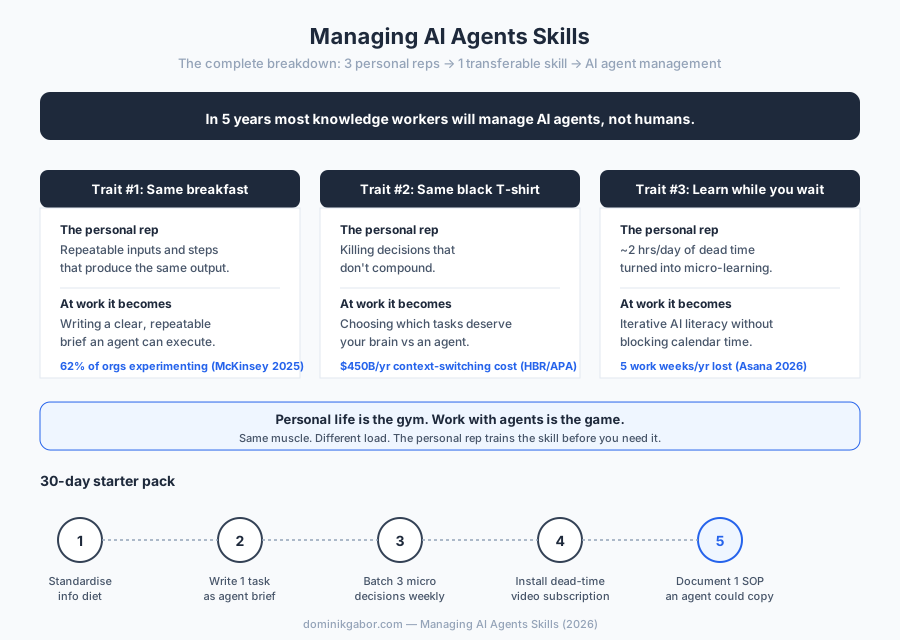
Save or share this. It's the full breakdown in one view.
Ready to See Your First Two Agent-Ready Workflows?
Book a free 30-minute AI Profit Assessment. We'll look at two repeatable tasks in your week, write the brief together, and map them to agents you can run yourself. No obligations, just two clear next steps you can act on the same week.
Most knowledge workers are surprised by how much of their week is already SOP-shaped once we map it out.
Book Your Free AI Profit Assessment Or start with the free AI workflow audit checklist →Share This Article
If this was useful, share it with a knowledge worker who's still convinced raw intelligence is enough.

About Dominik Gabor
AI Automation Consultant at TwinScale AI in Leeuwarden, the Netherlands. Dominik helps small and mid-size businesses implement AI Operating Systems, from lead response automation to strategic daily briefings. He tests 27+ AI tools daily.