
What These Two Models Actually Are
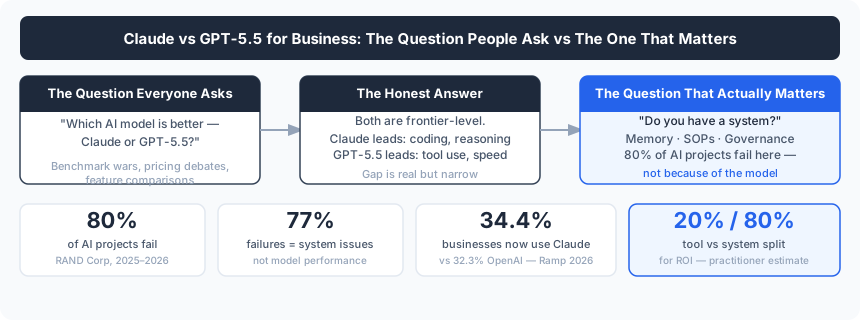
The Claude vs GPT-5.5 for business debate is everywhere right now. Most of it is asking the wrong question.
Every week, founders and COOs reach out asking whether they should use Claude or ChatGPT. They have read comparison posts, watched YouTube breakdowns, and scrolled Reddit threads. They treat the model choice like it is the most important decision in their AI strategy. I have watched this happen dozens of times with European SMEs, and I will tell you directly: the tool debate is mostly a distraction.
That said, the benchmarks are real. The differences matter for specific use cases. And with GPT-5.5 releasing in April 2026 and Claude Opus 4.8 following in May 2026, it is worth doing the honest comparison once. Then moving on to what actually drives ROI.
This is a comparison of Anthropic's Claude Opus 4.8 and OpenAI's GPT-5.5, the two current flagship AI models, evaluated specifically for business automation use cases: workflow automation, knowledge work, document processing, customer service, and coding-agent applications. The comparison also covers their respective coding tools: Claude Code and Codex CLI.
Claude Opus 4.8 is Anthropic's flagship reasoning model, released May 28, 2026. It is designed for high-stakes analysis, complex multi-file software engineering, and long-context knowledge work. Pricing: $5 per million input tokens, $25 per million output tokens (Anthropic, 2026).
GPT-5.5 is OpenAI's current flagship, released April 2026. It is positioned around agentic workflows: planning, tool use, and operating software end-to-end. Pricing: $5 per million input tokens, $30 per million output tokens (OpenAI, 2026).
Same input cost. GPT-5.5 costs 20% more on outputs at list price. But GPT-5.5 uses roughly 72% fewer output tokens on coding and agentic tasks, which narrows the effective cost gap significantly depending on your workload.
Both support context windows up to one million tokens. Both prohibit training on API customer data by default. Both work with major automation platforms including n8n, Make, and Zapier.
The Benchmark Breakdown: Where Each Model Wins
Benchmarks are not the whole picture. They are specific, and specificity beats opinion. Here is what the data shows.

Where Claude Opus 4.8 Leads
Deep software engineering. On SWE-Bench Pro, which evaluates real GitHub issue resolution across multiple programming languages, Claude Opus 4.8 scores 69.2% versus GPT-5.5's 58.6% (Anthropic, 2026). That is a meaningful gap. Claude is less likely to let subtle code flaws pass without flagging them.
Computer-use tasks. On OSWorld-Verified, which measures an agent operating a real Ubuntu desktop environment, Claude Opus 4.8 scores 83.4% versus GPT-5.5's 78.7% (Anthropic, 2026).
Knowledge work and reasoning. On GDPval-AA, a benchmark designed to simulate economically valuable tasks across professional occupations, Claude Opus 4.8 holds the top Elo score at 1,890, with GPT-5.5 at 1,769 (BenchLM.ai, 2026). On Humanity's Last Exam, Claude scores 57.9% with tools versus GPT-5.5's 52.2%.
What this means for your business: Claude is the stronger choice for analytical work, complex document review, legal or financial analysis, and anything where catching errors matters more than speed.
Where GPT-5.5 Leads
Terminal and DevOps workflows. On Terminal-Bench 2.1, which tests live command-line workflows requiring planning and iterative tool use, GPT-5.5 scores 82.7% versus Claude's 74.6% (OpenAI, 2026).
Tool-use agents. On τ²-Bench Telecom, which simulates customer-service agents using APIs to resolve complex multi-turn tasks, GPT-5.5 scores 98.0% compared to Claude's 88.6% (OpenAI, 2026). GPT-5.5 is exceptionally capable when it needs to orchestrate tools and systems in sequence.
Financial automation. On FinanceAgent, GPT-5.5 scores 60.0% versus Claude Opus 4.8's 53.9%.
What this means for your business: GPT-5.5 is the stronger choice for process-automation pipelines that need to orchestrate many tools rapidly, including customer support flows, operations automation, and back-office workflows where speed and tool-calling accuracy matter most.
The Honest Summary: Both Are Frontier-Level
| Benchmark | Claude Opus 4.8 | GPT-5.5 | Winner |
|---|---|---|---|
| SWE-Bench Pro (coding depth) | 69.2% | 58.6% | Claude |
| Terminal-Bench (command-line) | 74.6% | 82.7% | GPT-5.5 |
| OSWorld-Verified (computer use) | 83.4% | 78.7% | Claude |
| GDPval-AA Elo (knowledge work) | 1,890 | 1,769 | Claude |
| τ²-Bench (tool-use agents) | 88.6% | 98.0% | GPT-5.5 |
| FinanceAgent | 53.9% | 60.0% | GPT-5.5 |
| Output pricing (per MTok) | $25 | $30 | Claude |
The gap between Claude and GPT-5.5 for business automation is real. It is also narrow relative to the gap between having a system and not having one. We will come to that shortly.
Claude vs GPT-5.5 in Practice: Three SME Scenarios
Benchmarks tell you how the models perform on standardized tests. This section tells you what those numbers mean when you are running a 15-person logistics company in Rotterdam or a professional services firm in Munich.
Scenario 1: Contract Review and Legal Document Analysis
Business type: A Dutch B2B services company, 20 employees, reviewing 30-50 supplier contracts per month.
The task: Extract payment terms, liability clauses, and auto-renewal conditions from PDF contracts. Flag anything that deviates from standard templates. Generate a one-page summary for the operations director.
Which model wins: Claude Opus 4.8, clearly. The GDPval-AA Elo score gap (1,890 vs 1,769) reflects exactly this kind of structured knowledge extraction. In practice, Claude catches subtle clause variations that matter: a 30-day payment term buried in a liability paragraph, an automatic renewal buried three pages deep. GPT-5.5 handles this task adequately, but the error rate on edge cases is higher.
Time saved: A task that took 45 minutes per contract drops to under 5 minutes with a well-structured prompt and Claude's AGENTS.md context loaded. That is roughly 40 hours per month for this company.
Scenario 2: Customer Service Automation with Tool Orchestration
Business type: A German e-commerce brand, 35 employees, handling 200+ customer enquiries per day across email and chat.
The task: Classify enquiries, pull order status from Shopify API, check returns policy from a knowledge base, and generate a personalized first-response draft. All in under 3 seconds.
Which model wins: GPT-5.5, by a meaningful margin. The τ²-Bench score (98.0% vs 88.6%) reflects real-world tool orchestration performance. When a response requires three sequential API calls, covering order lookup, inventory check, and returns eligibility, GPT-5.5 handles the chaining more reliably and with fewer dropped steps.
Time saved: At 200 enquiries per day, even a 2-minute reduction in average handle time saves 6.7 hours of staff time daily. Over a month, that is roughly 140 hours. Enough to avoid the next customer service hire.
Scenario 3: Weekly Business Intelligence Report
Business type: A Netherlands-based professional services firm, 12 employees, with data spread across HubSpot, Google Analytics, and a project management tool.
The task: Pull the week's pipeline, revenue, and utilization data. Identify anomalies. Write an 800-word executive briefing with recommended actions. Deliver every Monday at 07:00 CET without human input.
Which model wins: Either works, but Claude's memory architecture makes it meaningfully better for this use case. Because the AGENTS.md file holds the firm's context (what a healthy pipeline looks like, which clients are at risk, what terminology the directors use), Claude produces briefings that read like they were written by someone who has been at the company for a year. GPT-5.5 can do the same with sufficient system prompt engineering, but the persistent context layer is less mature.
This is the scenario where the AI Operating System matters most. Both models produce generic output without it. With it, both produce output that is actually useful. The difference in model performance here is smaller than the difference in context quality.

Claude Code vs Codex CLI: For Builders
If you are building automation systems rather than just using chat, the tool comparison shifts from models to coding agents.
Claude Code runs in your terminal and is powered by Claude Opus. It builds a full understanding of your codebase before writing code, supports multi-agent orchestration, and uses AGENTS.md files to maintain persistent project context and SOPs across sessions. Speed: 15–25 tokens per second. SWE-Bench Verified score: approximately 80.8%. Pricing: Pro $20/month, Max 5× $100/month, Max 20× $200/month (shared token pool with Claude chat).
Codex CLI is OpenAI's open-source coding agent, built on GPT-5.x models. It prioritizes speed (65–70 tokens per second, roughly 3× faster than Claude Code), token efficiency (2–3× fewer tokens per task), and tight CI/CD integration. It excels at terminal-native execution and rapid iteration. The CLI itself is free; underlying model costs depend on which GPT model you route through it.
For business automation specifically, the difference comes down to one question: do you need persistent memory and system-level context, or raw speed and throughput?
Claude Code wins on the first. Codex CLI wins on the second.
One data point worth noting: Claude Code is now estimated to author around 4% of all public GitHub commits worldwide, a figure that doubled in a single month in early 2026 (Kharazian, 2026). Whatever the benchmark says, adoption speaks.
If you want to understand which tool architecture fits your specific workflows, book a free AI Profit Assessment. It takes 30 minutes and costs nothing.
The Part of the Claude vs GPT-5.5 Debate Nobody Talks About
Here is the data most comparison posts skip.
Multiple independent analyses of large-scale enterprise AI deployments reach the same conclusion: approximately 80% fail to deliver intended value, and the cause is almost never the model. RAND's review of more than 2,400 enterprise AI initiatives confirmed this pattern (RAND Corporation, 2025–2026). MIT's NANDA research found that 95% of generative AI pilots produced no measurable impact on profit and loss (MIT NANDA, 2026). Folio3's study of 140 enterprise AI implementations is the most specific: only 23% of failures came from model performance or integration complexity. The other 77% were failures of strategy, governance, and change management (Folio3, 2026).
Three percent of failures trace back to the model. The debate you are reading right now, Claude vs GPT-5.5, accounts for 3% of what determines your outcome. The other 97% is system design.
These are not edge cases. They are the norm.
Deloitte surveyed 3,235 senior leaders for their 2026 State of AI report and found that skills gaps and change management challenges, not model accuracy, are now the biggest barriers to AI integration. Only one in five companies has a mature governance model for autonomous AI agents (Deloitte AI Institute, 2026).
McKinsey's research on the same question is equally direct: companies realizing material financial returns from AI are those that redesign workflows and embed AI into operating models, not those that layer tools onto existing processes (McKinsey & Company, 2026).
The pattern is consistent across every serious analysis of AI outcomes at scale. The model matters. The system around it matters more.
Not sure if you have the right system in place? The Free AI Profit Assessment maps your current workflows in 30 minutes and tells you exactly what you're missing before you spend anything on implementation.
Book Your Free AssessmentWhat "The System" Actually Means
When working with European SMEs on AI implementation, the first question is not "which model do you want to use?" It is: "What does your AI know about your business?"
Most companies answer that question with silence.
No structured memory. No documented SOPs that the AI can reference. No context about how decisions get made, what the edge cases are, who owns what, or what the output should look like. They are prompting from scratch every session, hoping consistency emerges from repetition. It does not.
The AI Operating System (AIOS) is the answer to this problem. It is not software. It is a complete system architecture:
- Memory layer: structured documentation of your business context, terminology, customer types, and decision rules, loaded into every AI session automatically
- SOP layer: documented workflows that define what the AI does in each scenario, what it escalates, and what format its output takes
- Tool layer: connected integrations (n8n, CRM, email, calendar) so the AI can act rather than just generate text
- Governance layer: human checkpoints, error handling, and audit trails
With an AIOS in place, Claude Opus 4.8 and GPT-5.5 both deliver strong, consistent, business-relevant results. Without it, both models produce inconsistent outputs that require constant human supervision to be usable.
The benchmark difference between Claude and GPT-5.5 on SWE-Bench Pro is 10.6 percentage points. The difference between having a structured system and not having one is closer to the 77% that fails versus the 23% that does not. That is not a close call.
What This Looks Like in Practice
A logistics company in the Netherlands came to me in early 2026. They had been "using AI" for six months: GPT-4o via the web interface, a few ChatGPT prompts bookmarked in the browser, one Zapier automation that sometimes worked. They were frustrated. The AI gave different answers on the same question depending on who asked it and how. Their team had stopped trusting it.
We spent the first session not touching the model at all. We documented: what their business actually does, what their service tiers are, how they handle exceptions, what their customer communication tone sounds like, what decisions require human approval, and what the output of each automated task should look like. We turned that into a structured context document (their CLAUDE.md equivalent) and connected it to their CRM and email via n8n.
Within three weeks, the AI was handling first-response emails, flagging delivery exception cases, and summarizing weekly operations reports. Consistent output. Zero model debates. They were still on Claude, the same model they had been dismissing as unreliable six months earlier. The model had not changed. The system around it had.
That is not a story about Claude being better than GPT-5.5. It is a story about what the system actually does. The model is the engine. The AIOS is the car.
If you want to see exactly what an AI Operating System looks like in practice for a European SME, the AI agents for business breakdown covers the full architecture: memory layer, SOP layer, tool connections, and governance checkpoints. It is the same system I build for clients, documented end-to-end.
My Personal Take: What I Use and Why
I use Claude Code. I have used it every day for the past year, building automation systems for European SMEs and running my own business on it.
My recommendation is not "Claude is objectively better." My recommendation is: pick one and commit.
Here is why. Both Claude and GPT-5.5 are capable of delivering 3–4× ROI for a single operator who understands what they are building. The model is not the limiting factor. Switching between tools every time a new benchmark drops is the limiting factor.
The Time I Almost Switched and Why I Did Not
When GPT-5.5 launched in April 2026 with its Terminal-Bench score and τ²-Bench tool-use numbers, I spent two days seriously evaluating whether to migrate. The numbers were real. On pure tool orchestration benchmarks, GPT-5.5 is ahead. I ran side-by-side tests on three workflows I run daily: a lead research pipeline, a content drafting sequence, and a client onboarding automation. GPT-5.5 was faster on all three. On the lead research pipeline, noticeably faster.
I did not switch. Here is the honest reason: speed was not my bottleneck. My bottleneck is always context: does the AI understand the specific business it is operating in? On that dimension, the AGENTS.md system I have built in Claude Code over two years of daily use is not something I can replicate in an afternoon. GPT-5.5 is faster in a vacuum. Claude Code plus two years of accumulated context wins in practice.
If I were starting from zero today and my primary use case was high-volume tool orchestration or CI/CD automation, I would give Codex CLI a serious evaluation. The speed and token efficiency advantages are real and they compound over thousands of tasks. But I am not starting from zero, and most businesses I work with are not either. They have existing systems, workflows, and institutional knowledge that needs to be encoded. That encoding process rewards consistency over raw performance.
Where Claude Code Has Failed Me
It is slow. On complex multi-file tasks, 15–25 tokens per second means waiting. If you have run a Codex CLI session at 65 tokens per second, coming back to Claude Code feels like dial-up. For rapid iteration, testing a hypothesis, rewriting a function, trying a different approach, the speed gap is genuinely frustrating.
It also hallucinates library versions and API signatures more than I would like on less common integrations. On well-documented tools like n8n, Notion, and standard REST APIs, it is reliable. On niche integrations, including some EU-specific SaaS tools and older enterprise APIs, it will confidently give you a method signature that does not exist. You learn to verify, but it costs time.
These are real limitations. I am not pretending Claude is flawless. I use it because the advantages on my specific workflows, multi-file reasoning, persistent context, and MCP integrations, outweigh these costs. Your situation may call for a different answer.
There is a real cost to switching that most comparisons ignore. Moving from Claude to GPT-5.5, or back, is not as simple as swapping an API key. You rebuild your AGENTS.md context files, retest your prompts for the new model's behavior, update your n8n or Make workflows that rely on model-specific output formats, and lose the accumulated knowledge of what works for your specific use cases. In my experience with European clients, a full context migration takes 8–12 hours of focused work per system, not including the debugging cycle that follows. That is a real cost that almost never appears in a benchmark comparison.
Consistency compounds. When you use the same tool for 12 months, you learn its specific failure modes. You build AGENTS.md files and memory structures that fit it. You know exactly how to prompt it for your specific use cases. You stop troubleshooting and start shipping.
I chose Claude Code specifically because it handles multi-file reasoning better, its memory architecture (AGENTS.md) aligns well with how I document client systems, and it integrates cleanly with the MCP tools I use daily: Notion, Gmail, Google Calendar. For building persistent AI systems rather than running one-off tasks, that architecture matters.
Across the Netherlands and Germany, the businesses I see succeeding with AI are not the ones who spent the most time debating which model to use. They are the ones who committed to a stack, built a system around it, and ran it for six months before questioning it.
Claude vs GPT-5.5: GDPR Compliance for European Businesses
For Dutch and German SMEs, the model debate has a legal dimension that most comparison posts ignore entirely. GDPR data residency is not a checkbox. For certain industries (healthcare, finance, legal), it determines whether you can use a given tool at all.
What Both Providers Get Right
Both Anthropic and OpenAI prohibit training on API customer data by default. Both publish Data Processing Agreements (DPAs) with EU Standard Contractual Clauses (SCCs) under GDPR Article 46. Both are SOC 2 Type II certified. For most SME use cases, including internal workflow automation, document summarization, and lead research, either provider is compliant if you are operating under a valid DPA.
Where They Differ: Data Residency
This is the meaningful gap. OpenAI offers EU-region processing via Azure OpenAI Service, with data centers in the Netherlands and France. When you route GPT-5.5 through Azure, your data never leaves EU territory, which satisfies both the letter and spirit of GDPR Chapter V on international data transfers.
Anthropic's direct API routes through US servers. The SCC cover is legally adequate under GDPR, but the data does cross borders. For companies subject to strict sector-level data residency requirements, including Dutch healthcare providers under NEN 7510, German financial institutions under BaFin guidelines, or any organization that has received specific data residency instructions from a DPA, this distinction is significant.
Claude is available with EU-region processing via two cloud providers: AWS Bedrock (EU-West-1 in Ireland, EU-Central-1 in Frankfurt) and Google Cloud Vertex AI (europe-west4 in the Netherlands). Both paths give you full EU data residency with Claude. They add infrastructure complexity. You are managing cloud provider credentials and API routing rather than calling Anthropic directly. But the capability is there.
The Practical Decision for Dutch and German SMEs
If your organization is already in the Microsoft Azure ecosystem, GPT-5.5 via Azure OpenAI is the path of least friction for EU data residency. The integration with Entra ID, Azure Key Vault for secrets management, and existing Azure compliance frameworks makes it significantly easier to satisfy an internal audit.
If you are AWS or GCP native, Claude via Bedrock or Vertex is equally straightforward. You also get the model performance advantages Claude holds on reasoning and coding correctness alongside full EU residency.
If you are using the direct API for either provider and you are not in a regulated sector: both are compliant. The SCC framework is well-established. Stop debating GDPR and start building the system.
One practical step regardless of which model you choose: request the provider's DPA, sign it, and store it in your compliance documentation. This takes 15 minutes and is the actual legal requirement, not the cloud region.
GPT-5.5: EU data residency available natively via Azure OpenAI (Netherlands + France DCs). Best for Azure-native organizations with strict residency requirements.
Claude Opus 4.8: EU data residency available via AWS Bedrock (Ireland/Frankfurt) or Google Cloud Vertex AI (Netherlands). Best for AWS/GCP organizations or those prioritizing coding and reasoning performance.
Both: No training on API data by default. DPAs with SCCs available. SOC 2 Type II certified.
How to Actually Choose
Here is a practical decision framework for European SME founders:
- What is your existing cloud stack? If you are deep in Microsoft Azure, GPT-5.5 via Azure OpenAI is the path of least friction: better EU residency, lower integration overhead. If you are on AWS or GCP, Claude via Bedrock or Vertex AI is equally viable.
- What type of work dominates your automation use case? Deep document analysis, complex reasoning, multi-file code changes: Claude. High-volume tool orchestration, customer service automation, rapid terminal workflows: GPT-5.5.
- Do you have an AI system in place? If you are still prompting ad hoc without structured memory and SOPs, the model choice is premature. Build the system first. The model is an implementation detail.
- Pick one and stay. Commit to a six-month trial. Build your context and memory layer around it. Measure actual outputs against your business KPIs, not benchmark scores.
You might also find it useful to read about AI agents for business in 2026 , which covers real use cases and implementation patterns that apply regardless of which model you choose. And if you want to know what to look for in an AI consultant, how to hire an AI automation consultant walks through the seven questions that separate consultants who deliver from those who overpromise. For context on where Dutch and German businesses actually stand with AI right now, the Dutch SME AI adoption statistics for 2026 give a grounded picture of the gap between what companies say they are doing and what they have actually built.
Frequently Asked Questions
Is Claude better than GPT-5.5 for business in 2026?
It depends on the task. Claude Opus 4.8 leads on deep reasoning, complex coding (SWE-Bench Pro: 69.2% vs 58.6%), and knowledge work. GPT-5.5 leads on tool orchestration and terminal-based automation (Terminal-Bench: 82.7% vs 74.6%). For most European SMEs, the difference in outcomes is marginal. What matters more is whether you have a system of SOPs, memory, and structured context around whichever tool you choose.
Claude Code vs Codex CLI: which is better?
Claude Code is better for deep, multi-file reasoning and persistent project context. Codex CLI is better for speed (65–70 tokens/sec vs 15–25) and token efficiency (2–3× fewer tokens per task). If you are building a persistent business automation system, Claude Code's AGENTS.md-based memory gives it a meaningful edge. If you need fast terminal-native execution and CI/CD integration, Codex CLI wins on cost and speed.
Does the choice of AI tool actually affect ROI?
Much less than most people think. RAND's analysis of 2,400+ enterprise AI initiatives found ~80% fail to deliver value and the cause is almost never the model. Folio3's study of 140 implementations found only 23% of failures came from model performance. The other 77% were failures of strategy, governance, and process design. Both Claude and GPT-5.5 are frontier-level models. The ROI gap between them is small compared to the gap between having a structured system and not having one.
What is an AI Operating System for business?
An AI Operating System is not software. It is a complete system: structured memory, documented SOPs, connected tools, and a defined workflow architecture that tells the AI what your business does, how it works, and what decisions it should make. The AIOS is what makes any frontier model, whether Claude or GPT-5.5, actually reliable and consistent in your business context. Without it, you are prompting from scratch every time.
Is Claude GDPR compliant for European businesses?
Both Anthropic and OpenAI prohibit training on API customer data by default and publish DPAs with EU Standard Contractual Clauses. The key difference: OpenAI offers EU-region processing via Azure OpenAI Service, meaning data never leaves the EU. Anthropic's direct API routes through US servers (covered by SCCs, but data crosses borders). Claude is available in EU regions via AWS Bedrock or Google Cloud Vertex AI, which is the recommended path for Dutch and German SMEs with strict data residency requirements.
The Bottom Line
Claude Opus 4.8 and GPT-5.5 are both frontier-level models capable of transforming how a European SME operates. Claude leads on deep reasoning and coding correctness; GPT-5.5 leads on tool orchestration and speed. The real differentiator is not which model you choose. It is whether you have built an AI Operating System around it.
Pick a model. Build the system. Stay consistent.
The businesses seeing 3–4× ROI from AI in 2026 are not the ones with the best model. They are the ones with the best system around their model. That system is what I help European SMEs build, and it starts with a 30-minute conversation.
References
- Anthropic. (2026, May 28). Introducing Claude Opus 4.8. Anthropic News. https://www.anthropic.com/news/claude-opus-4-8
- BenchLM. (2026). GDPval-AA leaderboard. BenchLM.ai. https://benchlm.ai
- Deloitte AI Institute. (2026). The state of AI in the enterprise: 2026 AI report. Deloitte. https://www.deloitte.com/us/en/...
- Folio3. (2026). Enterprise AI implementation failure analysis: 140 deployments reviewed. Folio3 Research.
- Kharazian, A. (2026, May 13). Anthropic beats OpenAI on business adoption. Ramp Leading Indicators. https://ramp.com/leading-indicators/ai-index-may-2026
- McKinsey & Company. (2026). State of AI trust in 2026: Shifting to the agentic era. McKinsey Tech Forward. https://www.mckinsey.com/...
- MIT NANDA. (2026). Generative AI pilots and P&L impact: Enterprise outcomes study. Massachusetts Institute of Technology.
- OpenAI. (2026). API pricing. OpenAI. https://openai.com/api/pricing/
- RAND Corporation. (2025–2026). Enterprise AI initiatives and value realization: Analysis of 2,400+ deployments. RAND Corporation.
The Complete Picture
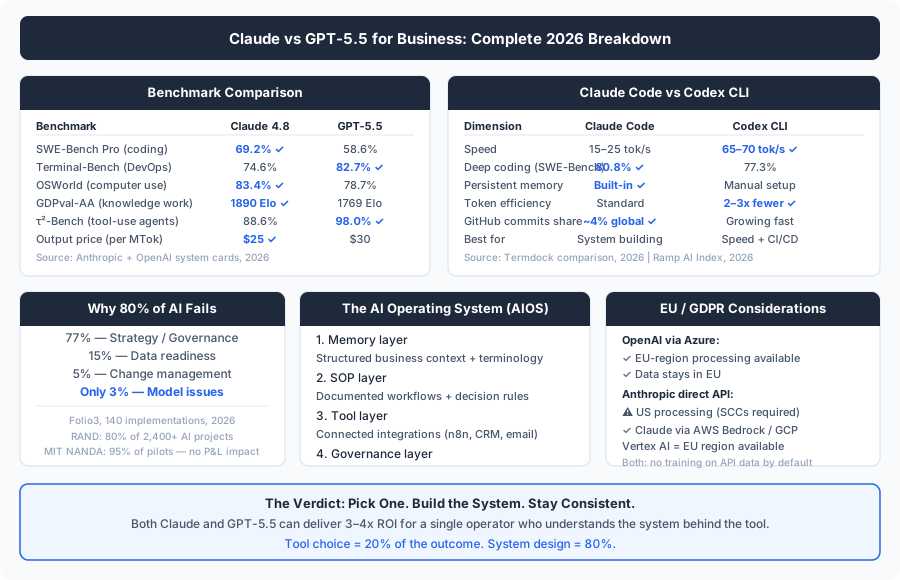
Save or share this. It's the full breakdown in one view.
Stop Debating Tools. Start Building the System.
The Free AI Profit Assessment is a 30-minute call where I map your current workflows, identify where AI can realistically save you 10+ hours per week, and tell you exactly which tools and architecture fit your situation, without the vendor bias.
Most European founders are surprised by how quickly the right system pays for itself, regardless of whether it runs on Claude or GPT-5.5.
Book Your Free AI Assessment Or start with the free AI workflow audit checklist →Share This Article
If this was useful, share it with a business owner who's still debating tools instead of building systems.

About Dominik Gabor
AI Automation Consultant at TwinScale AI in Leeuwarden, the Netherlands. Dominik helps small and mid-size businesses implement AI Operating Systems, from lead response automation to strategic daily briefings. He tests 27+ AI tools daily.