
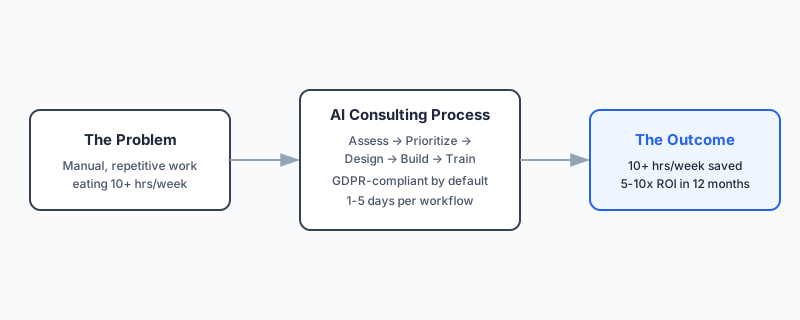
Most European SMEs looking for AI consulting find the same thing: guides written for companies with a procurement department and a seven-figure budget. Dominik Gabor, an AI automation consultant based in the Netherlands, has spent 2+ years building AI automations for European SMEs, and the pattern is consistent. A 15-person logistics company and a 200-person consulting firm are not shopping for the same thing, but the content available to both is identical. This guide is written for the first company, not the second.
AI consulting is the process of assessing a business's manual, repetitive work and designing AI-powered systems to handle it. For European SMEs, that means workflow automation, tool integration, and team training delivered by someone who understands both the technology and GDPR requirements. It ranges from a single Free AI Profit Assessment to full implementation of automated systems across a company's operations.
What AI Consulting Actually Means for a 5-100 Person Company
Strip away the marketing and AI consulting for a smaller business breaks into four real activities: assessing what's currently manual, deciding what's worth automating first, building the systems, and training the team to use them. That's it. There's no proprietary AI model involved, no six-month "digital transformation" program, and usually no need for a data science team.
For a company your size, the entry point is almost always the same three questions. What is your team spending hours on that a machine could do in seconds? What tools are you already using that don't talk to each other? And what would you build if you had someone technical on staff full-time, but you don't?
A good consultant answers those questions with specifics, not frameworks. If the first meeting produces a slide deck full of quadrants and no mention of your actual CRM or invoicing tool, that's a signal.
The 4 Types of AI Consulting (And Which One You're Actually Buying)
Not every consultant offers the same thing, and knowing which type you're talking to saves you from a mismatch. This distinction matters more than most buyers realize going in.
Strategy consulting produces a roadmap: what to automate, in what order, with what expected return. You walk away with a plan, not a working system. This is useful if you have internal technical capacity to execute it, but expensive if you don't.
Implementation consulting is the opposite: you bring the plan (or a rough idea), and the consultant builds it. Workflows get connected, automations go live, systems ship. This is where most of the actual value gets delivered for SMEs, because a plan without execution changes nothing.
Training and enablement teaches your existing team to use AI tools effectively, whether that's prompt engineering, using custom GPTs, or operating the automations someone else built. This matters for adoption but doesn't solve the "we don't have anyone who can build this" problem on its own.
Full-service consulting combines all three: assess, build, train, and often maintain. For a 5-100 person company without a dedicated technical hire, this is usually the right model, because it's the only one that doesn't leave a gap between the plan and the working result.

| Type | What you get | Best for | Typical risk |
|---|---|---|---|
| Strategy only | Roadmap, recommendations | Companies with internal builders | Plan never gets executed |
| Implementation only | Working automations | Companies with a clear plan already | May not fit your actual workflow |
| Training only | Team skill-up | Companies with existing tools, low adoption | No new systems get built |
| Full-service | Assessment + build + train + maintain | Most SMEs with no dedicated AI hire | Higher upfront cost |
The European Advantage: GDPR, Local Understanding, and Time Zones
Working with a Europe-based AI consultant instead of a US-based tool vendor or offshore agency changes three things in practice, not just in principle.
GDPR compliance has to be designed in from the start, not retrofitted. That means knowing which AI tools store data where, how to configure retention policies, and which vendors offer EU data residency. A consultant who has done this for other European businesses will have already made these decisions once; you're not the test case.
Local business understanding matters more than it sounds like it should. A consultant who has worked with Dutch, German, or other European SMEs understands things like the tight labor market driving automation from necessity rather than novelty, or the preference in some markets for thorough, tested rollouts over "move fast and break things." That shapes how a project gets scoped and delivered.
Time zone alignment sounds minor until you're waiting three days for a Slack reply from a US-based agency because your urgent question landed at 2am their time. For an implementation project with a tight feedback loop, being in the same working day matters.
If you want a straight assessment of what this looks like for your specific workflows, a free AI Profit Assessment takes 30 minutes and no obligation.
Industry-Specific Applications Across European SMEs
AI consulting isn't generic. What gets built for an e-commerce company looks nothing like what gets built for a logistics operation, and a consultant who proposes the same three automations to every client hasn't actually looked at your business.
E-commerce SMEs typically see the fastest ROI from inventory syncing across sales channels, AI-drafted customer service responses for common questions, and automated content generation for product listings. A 20-SKU shop and a 2,000-SKU shop need different architectures here, but the categories are consistent.
Professional services firms (agencies, consultancies, legal, accounting) get the most value from document automation: contract generation, report drafting, and client communication templates that pull from a knowledge base instead of getting written from scratch every time. The bottleneck in these businesses is almost always billable-hour time lost to non-billable admin.
Logistics and operations-heavy businesses benefit from route optimization, automated status updates to customers, and warehouse or inventory tracking that doesn't require manual spreadsheet updates. These automations tend to have the clearest, most measurable time savings because the manual process they replace is so visible.
General operations across any SME, regardless of industry, usually has three automatable pockets: HR workflows (onboarding, leave requests, policy Q&A), finance (invoice processing, expense categorization), and reporting (pulling data from multiple tools into one weekly summary). These are rarely industry-specific, which is why they're often the first thing implemented.
How the AI Consulting Process Actually Works, Step by Step
Here's what a real engagement looks like, stripped of the sales language.
1. The assessment. A working consultant starts by mapping what you actually do, not what you say you do. That usually means a conversation (30-90 minutes) walking through your team's actual weekly tasks, followed by identifying the 3-5 processes with the highest time cost and lowest complexity to automate. This is where the "Time × Frequency" filter matters: a task that takes 20 minutes but happens 50 times a week outranks a task that takes 3 hours but happens once a month.
2. Prioritization. Not everything identified in Step 1 gets built at once. A good consultant ranks opportunities by effort-to-impact ratio and picks the highest-impact, lowest-effort item first. This isn't just good practice, it's how you build internal trust in the process before asking for buy-in on bigger changes.
3. Design. Before anything gets built, the automated version of the workflow gets mapped out, usually as a simple diagram: trigger, steps, output. This is the point to catch mismatches between what leadership assumes happens and what actually happens on the ground.
4. Build. The first automation gets built and tested against real data, not a demo scenario. For a well-scoped single workflow, this typically takes 1-5 days. Full implementations covering multiple processes run longer, but the first working piece should ship fast enough that you see something real within the first week or two.
5. Test and refine. Automated and manual processes often run in parallel for a short window (a few days to a week) to catch edge cases before the team fully switches over.
6. Team onboarding. The system only creates value if the team actually uses it. This step gets skipped by consultants optimizing for "project delivered" over "project adopted," and it's the single biggest predictor of whether an implementation sticks.
7. Measure and iterate. Track hours saved, error rates, and adoption over the following weeks. What gets measured in month one usually looks different from what gets measured in month three, because the team starts finding new opportunities once they trust the first automation.
What Results to Realistically Expect (And In What Timeframe)
A realistic target: 10+ hours/week saved once the first 2-3 automations are live, typically within the first 30 days, when the project targets genuinely repetitive work. Measure it, don't assume it.
Full ROI on the consulting investment usually lands in the 5-10x range within 12 months, factoring in labor cost saved, error reduction, and the compounding effect of a team that's no longer bottlenecked on manual work. The compounding matters: month two is usually more valuable than month one, because the team has stopped thinking about the automation as new and started building on top of it.
What doesn't happen: instant transformation, zero-effort setup, or results in week one on anything beyond the simplest single workflow. Anyone promising that is selling, not consulting.
Red Flags: How to Spot a Bad AI Consultant
A few patterns show up consistently across bad engagements, and they're worth screening for before you sign anything.
Vague case studies without specific numbers ("we helped a client save time") instead of specifics ("we cut invoice processing from 3 hours to 20 minutes for a 30-person firm"). Real work produces real numbers; anyone who can't give you one hasn't actually delivered results, or won't share them.
GDPR treated as an afterthought or an upsell rather than a default. If data privacy comes up only when you ask, that's backwards.
No clear process, just a promise of "we'll figure it out together." A consultant who can't describe what week 1 through week 4 looks like hasn't done this enough times to have a repeatable method.
Recommending the same tool stack to every client regardless of what they already use. If the answer to "what tools should we use" is identical before they've seen your current systems, they're selling a product, not solving your problem.
Guaranteed ROI numbers before any assessment has happened. Nobody can promise a specific return before they've seen your actual processes.
For a longer breakdown of exactly what to ask before signing, see how to hire an AI automation consultant, which covers the 7 questions that separate real builders from pitch-deck sellers.
The Future of AI Consulting in Europe
Three shifts are already visible heading into the second half of 2026. First, the line between "consulting" and "implementation" is collapsing, businesses increasingly want systems delivered, not just strategy documents, and consultants who only offer the latter are losing ground. Second, GDPR and the EU AI Act are creating real differentiation for consultants who build compliance in from day one versus those treating it as paperwork. Third, the "AI Operating System" model, where a business's tools, data, and automations are connected as one system rather than a pile of disconnected point solutions, is becoming the standard expectation rather than a premium offering.
For Dutch and German SMEs specifically, this means the consultants worth hiring in the next 12 months are the ones already building this way, not retrofitting it.
If your team is doing work by hand that a system could handle, a free AI Profit Assessment will show you exactly where, and what it's costing you monthly.
Getting Started: Your First Step
You don't need a six-month plan to start. You need one conversation that identifies your highest-impact, lowest-effort automation opportunity, and a consultant honest enough to tell you if you're not ready yet. Start there.
Frequently Asked Questions
What does an AI consultant actually do?
An AI consultant maps your manual processes, identifies which ones AI can handle reliably, and builds the systems to run them. That includes workflow automation, connecting your existing tools, and training your team to use what gets built. A good consultant delivers working systems, not a strategy deck you have to implement yourself.
How much does AI consulting cost for a small business in Europe?
The first step is usually free: a 30-minute assessment of where AI saves your team time. A first paid project, one automation live in two weeks, starts around €1,000 excl. BTW. A full system is priced per project on the value it creates, with a fixed price agreed before any work starts. Get an ROI estimate before signing anything larger than an assessment.
Is AI consulting worth it for a small or mid-size business?
For companies with at least 3 repetitive manual processes eating 5+ hours a week, yes. The typical European SME sees 10+ hours saved weekly within 30 days of a well-scoped implementation, with 5-10x ROI on the consulting fee within 12 months. It is not worth it if your core processes aren't documented yet or you're mid-restructuring.
What's the difference between AI consulting and AI implementation?
AI consulting on its own often means strategy: an assessment, a roadmap, a set of recommendations you then have to execute. AI implementation means the consultant builds the automations, connects the tools, and hands over a working system. Full-service consultants do both. If a consultant only offers strategy, ask who builds it afterward.
Is AI consulting GDPR-compliant by default?
It should be, but it isn't automatic. Any consultant working with EU businesses needs to design data flows, storage, and AI tool selection with GDPR in mind from day one, not bolt on compliance after the system is built. Ask specifically how they handle data residency, retention, and what happens to your data inside the AI tools they recommend.
The Bottom Line
AI consulting for a European SME should look nothing like AI consulting for an enterprise. If a consultant's process, pricing, or case studies sound like they're describing a Fortune 500 engagement, you're either overpaying or about to get under-delivered. Find someone who talks in hours saved and workflows built, not frameworks and quadrants.
The honest version of AI consulting is less exciting than the marketing suggests: assess what's manual, automate what's worth automating, train the people using it, measure what changed. Done well, it pays for itself within a year and keeps compounding after that. Done badly, it's a slide deck nobody executes.
Start with the assessment. Everything else follows from what it actually finds.
The Complete Picture
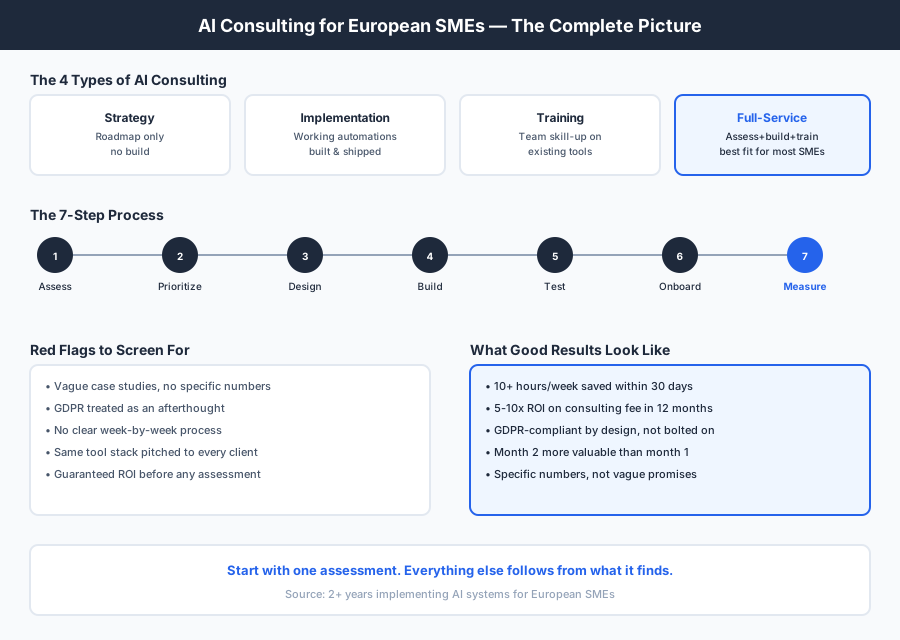
Save or share this: the full breakdown in one view.
Ready for an Honest Assessment of Your AI Options?
Book a free 30-minute AI Profit Assessment. Get a detailed analysis of your workflows and discover exactly where AI can save your team time and boost profits. No obligations, just actionable insights, in the same straight-talk style as this guide.
Most business owners are surprised by how much of their week is automatable once we map it out together.
Book Your Free AI Profit Assessment Or start with the free AI workflow audit checklist →Share This Article
If this was useful, share it with a business owner who's still shopping for AI consulting quotes sized for enterprise budgets.

About Dominik Gabor
AI Automation Consultant at TwinScale AI in Leeuwarden, the Netherlands. Dominik helps small and mid-size businesses implement AI Operating Systems, from lead response automation to strategic daily briefings. He tests 27+ AI tools daily.