
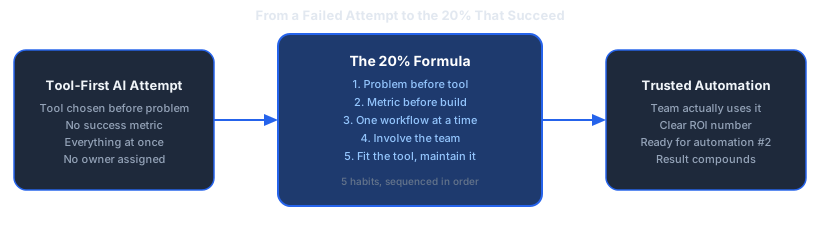
Ask ten business leaders whether their AI project succeeded, and roughly eight will hesitate before answering. That hesitation is the real story behind the AI failure statistics. It is not a wave of exploded budgets. It is a slow drift where a pilot never quite becomes a habit, and nobody wants to be the one who says out loud that it did not work.
Dominik Gabor, an AI automation consultant based in the Netherlands, has watched this pattern from both sides. He has scoped AI Operating System builds for businesses that got their first attempt right, and he has diagnosed exactly where an earlier, failed attempt went wrong before his firm ever got involved. The failures rarely trace back to the technology itself. They trace back to a short list of decisions, made or skipped, in the first few weeks.
This post covers that short list: the six reasons AI projects fail most often, a worked example of one playing out, the pattern the successful 20% share, and a practical way to check which side of that line your own plan currently sits on.
An AI project counts as a failure when it does not reach the outcome it was funded to produce. That does not require a dramatic technical collapse. Most AI failures are quiet: a working automation nobody uses after month two, a pilot that never gets budget to scale, or a tool subscription that lapses because nobody could point to a measurable result. The project simply stops being anyone's priority.
Key Takeaways
- The failure rate cited varies widely, anywhere from 70% to 95% depending on the source, but the reasons behind it move far less than the number itself.
- 6 recurring causes account for most failures: starting with the tool, no success metric, automating everything at once, no change management, the wrong tool for the task, and no maintenance owner.
- The pattern is organizational, not technical. Leadership follow-through and sequencing decide the outcome more often than model quality.
- The successful 20% share 5 habits: problem first, metric before the build, one workflow at a time, involve the team, fit the tool and maintain it.
- A short structured check, like a Free AI Profit Assessment, run against a plan before it starts building typically catches several of these failure risks while they are still cheap to fix.
The Failure Stat: Where It Comes From and What It Actually Means
Search "why do AI projects fail" and the numbers you find will not agree with each other. Some sources cite roughly 80%. Others put it closer to 70%. Reports focused specifically on generative AI pilots have put the figure as high as 95%. By some estimates, the count depends heavily on what "counts" as failure and which sample of projects gets measured, since a large enterprise AI program, an SME automation, and a generative AI pilot each produce a different number.
What does not move nearly as much, across every version of this research, is the list of reasons. Whichever number you land on, the underlying causes repeat: unclear success metrics, weak data foundations, poor integration into how people actually work, chasing technology instead of a business outcome, and executive sponsorship that fades once the initial announcement wears off. Several 2026 industry analyses converge on the same conclusion: the root causes are overwhelmingly organizational and leadership-driven, not technical. Whatever the precise percentage, the pattern behind it is consistent enough to plan around.
The 6 Reasons AI Projects Fail
1. Starting with the tool, not the problem
A team gets excited about a specific AI tool, often after a demo or a competitor mention, and starts hunting for a use case to justify buying it. The order should run the other way: name the highest-cost manual process first, then pick whichever tool actually fits it. Projects that start with the tool tend to produce a working demo for a low-priority task while the process actually costing the business money stays untouched.
2. No success metric defined before starting
If nobody agreed on what "success" looks like before the project began, nobody can agree afterward whether it delivered. "Be more efficient" cannot be checked against anything. "Cut invoice processing time from 3 days to same-day" can. Projects without a number attached tend to quietly become "still evaluating" by month six, because there was never a finish line to cross.
3. Trying to automate everything at once
Ambition is not the problem. Sequencing is. Teams that launch five automations in the same month typically finish testing and refining none of them properly, because each one needs real attention in the first few weeks to catch the edge cases the initial plan missed. One workflow running reliably beats five workflows half-built.
4. No change management, so the team resists quietly
An automation that replaces part of someone's daily routine, even a routine they complained about, still requires that person to trust it before they stop double-checking it by hand. Skip the conversation about why the change is happening, and the automation runs in parallel with the old manual process indefinitely, which cancels out the time it was supposed to save.
5. Choosing the wrong tool, shiny object syndrome
The newest, most talked-about AI tool is not automatically the right one for a specific workflow. A general-purpose chatbot bolted onto a process that needed a structured, rule-based integration produces inconsistent output and erodes trust fast. Fit the tool to the task, not the other way around. For businesses in the Netherlands, Germany, or elsewhere in the EU, this reason carries an added layer: a tool that looks like the obvious choice everywhere else may still need a GDPR-compliant configuration, and discovering that mid-rollout costs far more than checking it during tool selection.
6. No plan for who maintains it
An automation shipped without an owner tends to break quietly the first time an upstream tool changes its interface or a data field gets renamed. Nobody notices for weeks, because the manual process it replaced no longer exists as a fallback. Every automation needs a named person checking it periodically, the same way a piece of physical equipment needs someone responsible for maintenance.
A Worked Example: One Reason in Practice
Here is what failure reason 3 looks like applied to a hypothetical 30-person e-commerce business in Utrecht.
In January, the operations lead returns from a conference energized about AI and pitches five automations in the same planning meeting: an AI chatbot for customer service, automated inventory reordering, an AI-drafted weekly sales report, automated returns processing, and an AI tool for supplier email summaries. Leadership approves all five, impressed by the ambition.
By March, the chatbot is live but gives customers inconsistent answers, because nobody had time to properly train it on the return policy edge cases. The inventory reordering tool is half-configured and still requires manual approval for every order, which defeats the point of building it. The weekly sales report automation works, but nobody trusts the numbers enough to stop building the old spreadsheet in parallel. The other two projects stall entirely once the operations lead gets pulled into fixing the chatbot.
Six months in, the business has one automation nobody fully trusts, two half-built, two abandoned, and a growing internal sense that "AI does not really work for us."
The fix, applied in hindsight: launch the sales report automation alone in January, since it had the clearest success metric (time to produce the report) and the lowest complexity. Confirm it is trusted and used for a full month before starting automation number two. By month six, that sequencing produces one fully working automation with the team's confidence intact, instead of five partial ones with none.
The 20% Formula: What Successful Implementations Have in Common
Flip the six failure reasons around and most of the pattern behind the businesses that succeed appears. Five habits show up consistently:
- Problem first, not tool. The highest-cost manual process gets named before any tool gets chosen.
- Metric before the build. A specific, checkable number gets agreed before work starts, not after.
- One workflow at a time. The first automation ships and earns trust before the second one starts.
- Involve the team. The people whose daily work changes get told why, and what happens to the time it frees up.
- Fit the tool, and maintain it. The tool gets chosen to match the task, and someone owns checking it keeps working.
None of these five habits requires a data science team or a six-figure budget. They require discipline about sequencing, most of which happens before a single line of automation gets built. That is also the exact shape of a short structured assessment: a 30-minute Free AI Profit Assessment, run against a plan before it starts building, typically surfaces two or three of these six failure risks while they are still a five-minute fix instead of a six-month one.
Pressure-test your AI plan before you build
Most AI projects fail for reasons that are obvious in hindsight and invisible before launch. In 30 minutes we run your plan against the six failure reasons above and find the weak points while they are still cheap to fix.
- The failure risks hiding in your current plan
- The one problem worth solving first
- A success metric you can actually measure
30 minutes. No obligation. No pitch unless you ask for one.
Or grab the free resources first →Check Your Plan Against the Same Framework Dominik Uses
For a fuller planning framework that builds these five habits into a repeatable process, the AI Strategy Canvas covered in the AI Strategy Playbook for SMEs walks through the same sequencing (assess, prioritize, choose tools, roadmap, metrics, scale) in more depth. It is the same structure Dominik uses when scoping an AI Operating System build for a client, adapted so any 10-50 person business can run through it first.
If a project is already mid-rollout and some of the six failure signs above sound familiar, the step-by-step workflow migration guide covers how to test an automation in parallel with the manual process before switching over fully, which is one of the more reliable ways to catch failure reason 4 before it costs the whole project. For businesses starting from scratch, the audit-to-build sequence in the complete guide to AI automation for SMEs covers the earlier planning steps this post assumes are already in place.
Warning Signs You're Already Off Track
A handful of signs tend to show up before a project fully fails, and catching them early is cheaper than a post-mortem.
- The project has been "in progress" for more than 90 days with no number to show for it.
- Two or more teams are quietly running the old manual process "just in case," alongside the new automation.
- Nobody can state, in one sentence, what problem the project was originally meant to solve.
- The person who championed the project internally has moved on or changed roles.
- A tool subscription renewal is coming up and nobody has checked whether anyone still uses it.
Any one of these on its own is not fatal. Two or more at the same time is usually a sign the project has already drifted into one of the six failure patterns above, and it is worth a short reset conversation before the renewal date arrives, not after.
Frequently Asked Questions
What percentage of AI projects actually fail?
Industry estimates vary widely. Some analyses cite roughly 70-80% of AI initiatives failing to deliver the expected value, and reports focused specifically on generative AI pilots have put the figure as high as 95%. The exact number depends on what counts as failure and which projects get sampled, but the reasons behind the number are far more consistent than the number itself, and they center on planning and follow-through rather than the underlying technology.
What is the single biggest reason AI projects fail?
Multiple 2026 analyses point to the same root cause: leadership and organizational follow-through, not technical limitations. In practice, that usually shows up as starting with a tool instead of naming the problem first, or losing executive sponsorship once the initial announcement excitement fades. Both are sequencing and ownership problems, not something a better model fixes.
How can a small business avoid being part of the AI failure statistics?
Name the single highest-cost manual process before choosing any tool, agree on one checkable success metric before building, and launch one workflow at a time instead of several at once. A short structured check, like a 30-minute AI Profit Assessment run against the plan before committing budget, typically catches two or three of the six common failure risks while they are still inexpensive to fix.
Does the AI project failure rate apply to small automation projects, or just large enterprise AI programs?
Both, though the specific failure modes shift by scale. Large enterprise AI programs tend to fail on data infrastructure and cross-department coordination. Smaller business automations, the kind most 10-50 person companies run, tend to fail on sequencing and change management instead: too many workflows launched at once, or a team that quietly reverts to the manual process because nobody explained why the change mattered. The fix for both is largely the same: name the problem, set the metric, and go one workflow at a time.
The Bottom Line
The exact failure number, whether it lands at 70%, 80%, or 95% depending on the source, matters less than the pattern underneath it. AI projects fail from sequencing and ownership mistakes made in the first few weeks, not from the technology itself. The 20% that succeed name the problem before the tool, set one metric before building, launch one workflow at a time, bring the team along, and assign someone to maintain what they build. None of that requires a bigger budget. It requires doing the five things in order.
If two or more of the six failure reasons above sound familiar for a project already underway, or a new one is about to start and the plan has not been checked yet, that is exactly what a Free AI Profit Assessment is built to catch, before the mistake gets expensive instead of after.
The Complete Picture
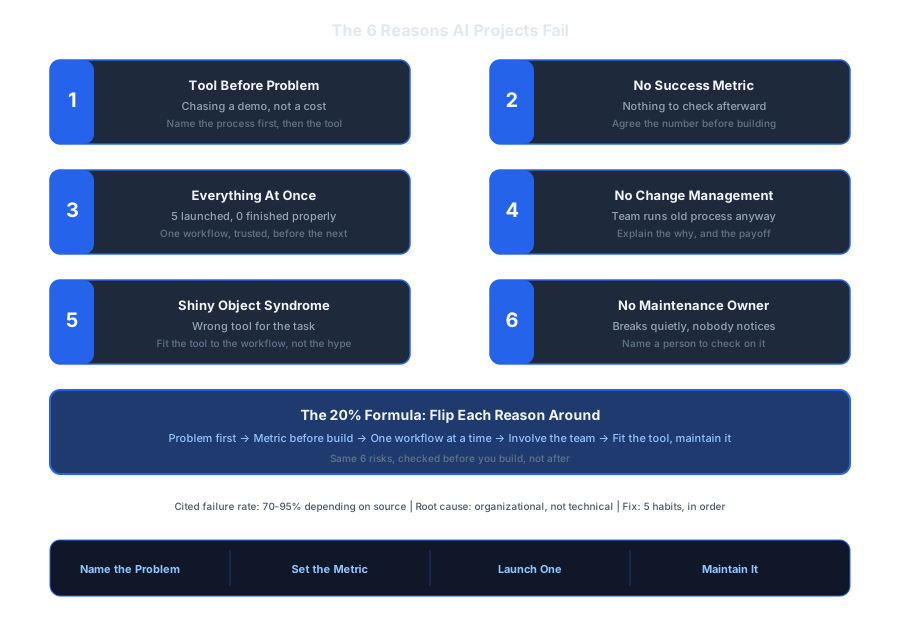
Save or share this: the 6 failure reasons and the 5-habit fix in one view.
Find Out Which Failure Risk Applies to Your Plan
Every AI project carries a different mix of these six risks. Book a free 30-minute AI Profit Assessment and leave with a clear answer: which failure reason is most likely to hit your project, and what the fix looks like before you commit budget.
Most leadership teams are surprised by how quickly the biggest risk becomes obvious once it's named.
Book Your Free AI Profit Assessment Or start with the free AI workflow audit checklist →
About Dominik Gabor
AI Automation Consultant based in the Netherlands. Dominik helps small and mid-size businesses avoid the sequencing and ownership mistakes that stall most AI projects, using the same planning discipline covered in this post. He has spent 2+ years testing 27+ AI tools daily, and writes to give business leaders the exact planning structure most AI content skips over.