
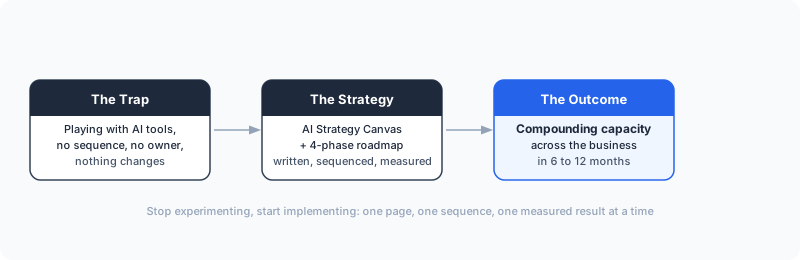
Your team has tried AI. Someone used ChatGPT to write an email, someone else summarised a meeting, and for a week it felt like the future. Then nothing changed. The tools went back in the drawer and the manual work carried on exactly as before.
That is the gap between experimenting with AI and having an AI strategy. An AI strategy for SMEs is not a pile of tools you are playing with. It is a written plan that connects specific problems in your business to specific automated solutions, sequenced so each step pays for the next. Across two years of building automation systems for European SMEs, the pattern is consistent: the businesses that win are not the ones with the most tools, they are the ones with a plan. Dominik Gabor, an AI automation consultant based in the Netherlands, has watched companies with smaller budgets and a clear strategy outrun better-funded competitors who never moved past the experiment.
It is a written plan that defines where AI will create measurable value in your business, the order you will implement it, and how you will know it worked. It connects manual problems to automated solutions on a single page, not a list of tools to try.
This playbook gives you the full picture: the trap most SMEs fall into, a one-page framework called the AI Strategy Canvas, a four-phase implementation roadmap, how to get leadership buy-in, how to build an AI-literate team without hiring specialists, and what six months of waiting actually costs you.
Key Takeaways
- Strategy is not experimentation: A real AI strategy is written, sequenced, and measured. Scattered tool use is none of those.
- The AI Strategy Canvas: Seven components on one page, from current-state assessment to scaling plan. If it does not fit a page, it is a wish.
- Four-phase roadmap: Quick wins, foundation, scaling, innovation, across 6 to 12 months.
- Start with proof, not transformation: One high-impact, low-effort win earns the belief that funds the rest.
- The cost of waiting is the biggest line item: It just never appears on a budget.
The Experimentation Trap
Most SMEs are stuck in the experimentation phase, and they do not know it. Experimentation looks productive. People are using AI, talking about AI, and feeling modern. But experimentation has no sequence, no owner, and no success metric. It produces anecdotes, not systems.
The numbers explain why this matters. An MIT study of AI in business found that 95% of companies saw zero return or "little to no measurable impact" from their AI investments, largely because the tools did not adapt to how the company actually worked (MIT, 2025). Read that again: not 95% of the technology failed. 95% of the implementations failed. The tools work. The strategy was missing.
There is a second, quieter cost to staying in experimentation: it teaches your team that AI does not deliver. After a few months of scattered tool use with no systematic result, people conclude AI is overhyped and stop trying. That belief is harder to undo than the original inertia. You do not just lose the time, you lose the willingness to try again.
A real AI strategy looks different from experimentation in three ways. It is written down, so it survives a busy week. It is sequenced, so the order is deliberate rather than whatever felt interesting. And it is measured, so you know whether it worked instead of guessing. Everything else in this playbook builds on those three properties.
For Dutch and German SMEs specifically, there is an added reason to be deliberate: most do not have an in-house data team to clean up a failed rollout. The strategy has to be right the first time because there is no one waiting to firefight it.
The AI Strategy Canvas
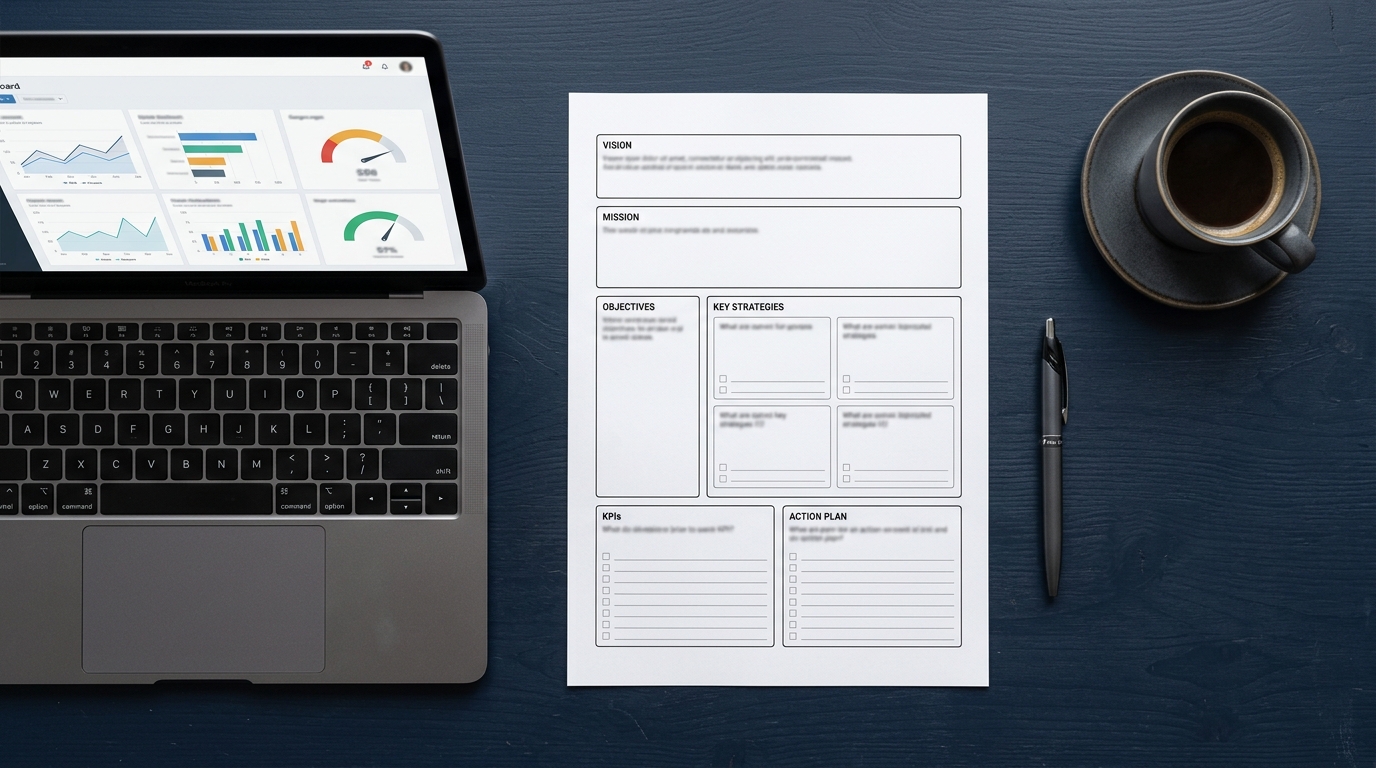
The AI Strategy Canvas is a one-page framework for turning vague AI ambition into a concrete plan. It has seven components, and you fill them in order. Each answers one question, and the answers feed the next. The point of fitting it on one page is discipline: if you cannot summarise your AI strategy on a single sheet, it is not a strategy yet, it is a wish.
1. Current State Assessment
Before you decide where AI goes, map where the time goes. List the processes your team runs every week and mark how much human time each one eats. Be specific. "Reporting" is not an entry. "The weekly sales report that takes Maria three hours every Monday" is an entry.
The output of this component is an honest inventory of repetitive work. Most SMEs are surprised here. Work that feels like a small task turns out to consume 10 to 20 hours a week across the team once you add it up. You cannot build a strategy on a guess about where time goes, so this assessment comes first.
2. Opportunity Identification
Now look at that inventory and mark which entries are candidates for automation. A good candidate is repetitive, rule-based, and follows a predictable pattern. A bad candidate requires judgment, relationships, or constant exception-handling on every instance.
This is where you separate "AI could theoretically do this" from "AI should do this now." The goal is a shortlist of five to ten real opportunities, each tied to a specific process from your Current State Assessment, not abstract ideas about what AI can do in general.
3. Prioritization Matrix
Not every opportunity is worth doing first. Score each one on two axes: impact (how much time or money it recovers) and effort (how hard it is to build and integrate). Plot them. The opportunities that are high impact and low effort are your starting line. The high impact, high effort ones are your second wave. Low impact opportunities wait, regardless of how easy they are.
This matrix is what stops the most common strategic mistake: starting with the most exciting project instead of the one that delivers the fastest, safest return. The prioritisation is the strategy. Everything before it is research.
4. Tool Selection
Only now do you choose tools, and you choose them to fit the workflow, not the other way around. The mistake is picking a tool first because it is popular, then forcing your processes to bend around it. Reverse that. Define what the workflow needs to do, then select the tool that does it.
For most European SMEs the practical stack is a workflow engine like n8n or Make connected to an AI reasoning layer like Claude. n8n is self-hostable, which matters for GDPR compliance because your data stays on your own infrastructure. The right tool is the boring one that fits, not the impressive one that does not.
5. Implementation Roadmap
This component sequences your prioritised opportunities into a timeline with owners. Each item gets a target window and a named person responsible. Without an owner, an initiative becomes everyone's job, which means no one's. Without a timeline, it slips behind whatever is on fire this week.
The roadmap is where strategy becomes operational. The four phases later in this playbook give you the standard shape: quick wins first, foundation second, scaling third, innovation fourth.
6. Success Metrics
Define how you will measure success before you build anything. For each initiative, write down the number that will tell you it worked: hours saved per week, response time reduced, errors eliminated, revenue influenced. Pick the metric first, because a metric chosen after the fact is a metric chosen to flatter the result.
This component is the one most SMEs skip, and skipping it is why so many AI projects end in a shrug. If you cannot say whether it worked, you cannot decide whether to scale it.
7. Scaling Plan
The final component answers a question most strategies never reach: once an automation works, how does it spread? A workflow that saves the sales team three hours a week is a win. The same pattern applied across marketing, operations, and finance is a transformation. The scaling plan turns single wins into compounding capacity.
Scaling is also where you institutionalise what you learned. The documentation, the prompt patterns, the integration approach: these become reusable assets, not one-off builds. That is how a small team gets leverage from AI without growing headcount.
If you want help filling in the first column of your own AI Strategy Canvas, book a free AI Profit Assessment and we will map your current state together in 30 minutes.
The AI Strategy Canvas in Action: A Worked Example
The canvas is easier to trust when you see it filled in. Here is how it plays out for a typical 30-person professional services firm, the kind of business I work with across the Netherlands and Germany.
Current State Assessment. The team sits down and lists its weekly processes with honest time estimates. Lead intake and qualification: 8 hours. Weekly client reporting: 6 hours. Invoice chasing: 3 hours. Meeting notes and follow-ups: 5 hours. Proposal drafting: 7 hours. Already that is 29 hours a week of repetitive work, most of it spread across people who each assumed their slice was small. Seeing it totalled on one page changes the conversation.
Opportunity Identification. Of those, proposal drafting needs judgment and stays human for now. The other four are repetitive and rule-based enough to be candidates. The firm now has a shortlist of four real opportunities, each tied to a concrete process and a real number of hours.
Prioritization Matrix. Scoring on impact and effort, lead intake is high impact (8 hours, and slow follow-up loses deals) and medium effort. Weekly reporting is high impact and low effort. Invoice chasing is medium impact and low effort. Meeting notes are medium impact and low effort. The starting line picks itself: weekly reporting and meeting notes are the low-effort high-return wins, with lead intake as the bigger second move.
Tool Selection. The workflows need to pull data from a CRM and an accounting tool, run it through an AI reasoning step, and deliver to email and a shared workspace. n8n connected to Claude covers all of it, self-hosted for GDPR. No new platform, no forcing the business to bend around a tool.
Implementation Roadmap. Weekly reporting goes first, owned by the operations lead, live in week two. Meeting notes second, week three. Lead intake in weeks four to six. Each has a name attached and a date, so none of it becomes "someone should do this eventually."
Success Metrics. Before building, the firm writes the numbers down: reporting time from 6 hours to under 1, meeting-note time from 5 hours to near zero, lead response time from a day to under an hour. Now there is no debate later about whether it worked.
Scaling Plan. Once the reporting automation works for the client team, the same pattern gets templated for internal management reporting and then for the finance team's monthly summary. One build, three applications. That is the leverage the canvas is designed to produce.
The whole canvas fits on a page, and filling it took the firm an afternoon. That afternoon replaced months of scattered experimentation with a sequenced plan everyone could see.
The Four-Phase Implementation Roadmap
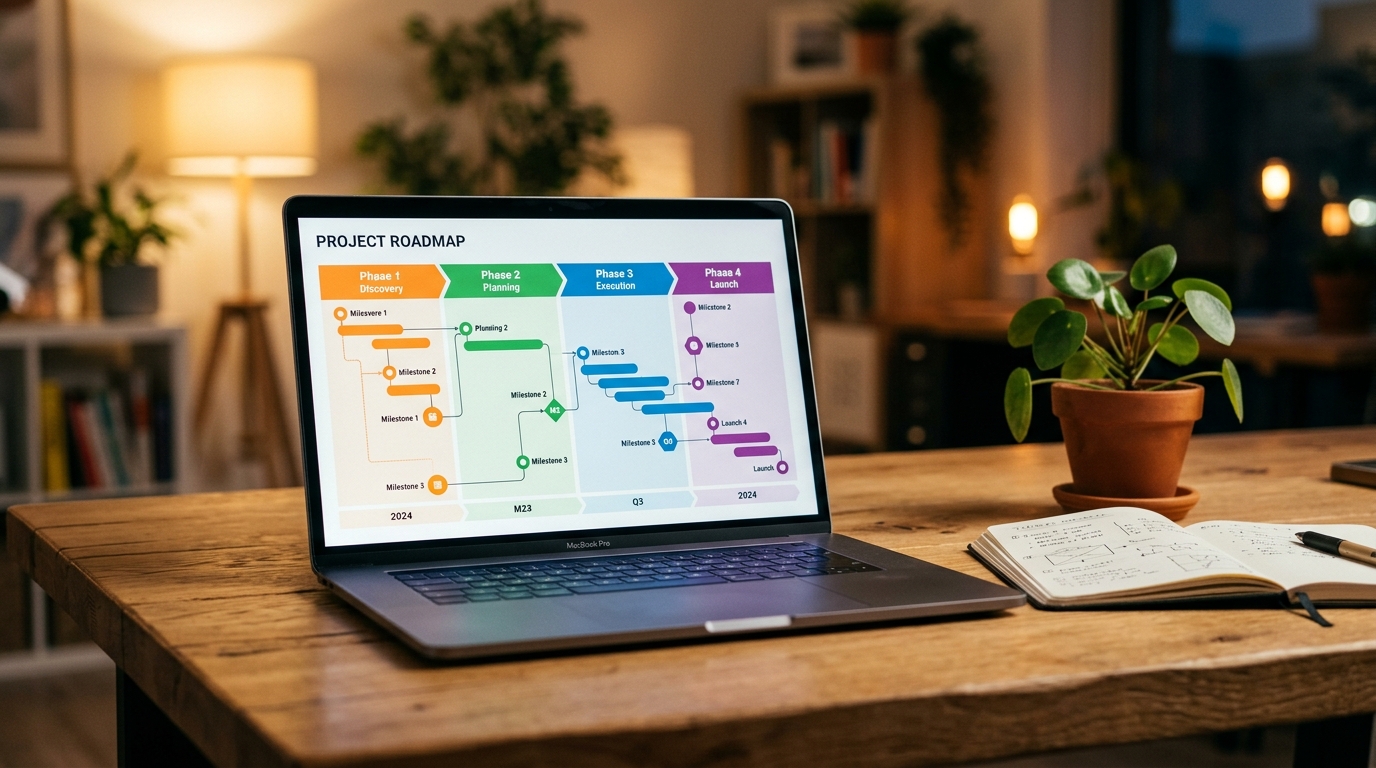
The AI Strategy Canvas tells you what to do. The four-phase roadmap tells you when. This is the standard sequence that turns a canvas into results over six to twelve months, the realistic window for an SME to move from first automation to AI embedded across the business.
Phase 1: Quick Wins (Weeks 1 to 4)
Start where the pain is visible and the risk is low. The goal of Phase 1 is not transformation, it is proof. You want one or two automations live and working within a month so the team sees that this is real and starts to trust it.
Good Phase 1 candidates are the high-impact, low-effort items from your Prioritization Matrix: automated lead follow-up, meeting summaries, invoice reminders, weekly report generation. Each saves a few hours a week and runs without a developer. The detail of how to choose and build these is in the no-code AI automation ideas post, and the safe way to move an existing manual process across is in the guide to manual to automated workflow migration.
The single most important outcome of Phase 1 is belief. A team that has seen one automation work will back the next ten. A team still waiting for proof will resist them.
Phase 2: Foundation Building (Months 2 to 3)
With early wins banked, Phase 2 builds the systems underneath. This is where you connect tools properly, standardise how data moves between them, and document the patterns that worked in Phase 1 so they can be reused.
Foundation work is less glamorous than quick wins, which is exactly why teams skip it and then wonder why their automations are fragile. The businesses that build a foundation in months 2 and 3 are the ones whose AI still works in month 12. The ones that keep bolting on quick wins without a foundation spend month 12 firefighting.
This phase is also where AI literacy starts to spread. The people who watched Phase 1 now start building. That capability transfer is part of the foundation, not separate from it.
Phase 3: Scaling (Months 4 to 6)
Phase 3 takes what works in one part of the business and spreads it across departments. The lead-response pattern that helped sales gets adapted for support. The reporting automation built for one team gets templated for three. This is where the time savings stop being incremental and start being structural.
Scaling is mostly a sequencing and documentation challenge, not a technical one. You already proved the patterns. Phase 3 is about applying them deliberately, in the order your Prioritization Matrix set, with the success metrics from your canvas tracking whether each rollout actually lands.
By the end of Phase 3, a well-run SME has AI doing meaningful work in most departments, with a team that can maintain and extend it. That is the point where the standard claim becomes real: 10 or more hours per week recovered across the business, permanently.
Phase 4: Innovation (Month 6 and Beyond)
The first three phases automate work you already do. Phase 4 is where AI starts enabling things you could not do before: faster decisions from always-current data, products or services that were not viable when everything was manual, response speeds competitors cannot match.
This is the phase that turns AI from a cost-saver into a competitive advantage. It only becomes available once the foundation is solid and the team is fluent, which is why it comes last. Trying to innovate before you have automated the basics is how the experimentation trap looks at a larger scale.
How to Get Leadership Buy-In
A strategy that the leadership team has not bought into does not get resourced, and an unresourced strategy is a document, not a plan. Getting buy-in is part of the strategy, not a separate political task.
The argument that works is not "AI is the future." It is specific and financial. Take one process from your Current State Assessment, quantify what it costs in labour today, and show what it costs after automation. "The weekly reporting process consumes six hours of senior time a week. That is roughly 300 hours a year. Here is the automation that reduces it to 30 minutes." That is a number a leadership team can act on.
Practitioner guides on building an SME AI roadmap stress that adoption is an organisational decision, not just a technology one, and recommend a small cross-functional steering group so AI initiatives stay aligned with business goals (The Marketing Centre, 2026). The reason is practical: leaders control budget, priority, and the permission for a team to spend time building rather than just delivering. Win that backing with one concrete ROI case, then let the early results argue for the rest.
Lead with the cost of the status quo, not the cost of the project. The relevant comparison is not "the automation costs X." It is "doing nothing costs Y every month, and Y is larger than X."
Building an AI-Literate Team Without Hiring Specialists
You do not need to hire AI specialists to execute this strategy. You need to make your existing team AI-literate, which is a different and far cheaper thing. AI literacy means a few people on your team can build, maintain, and improve workflows using no-code tools. It does not mean everyone becomes a data scientist.
The practical path is to pick one or two capable people, give them ownership of the early automations, and let them learn by building the Phase 1 quick wins with outside help for the initial setup. By Phase 2 they are building independently. By Phase 3 they are teaching others. This is how a 30-person company ends up with real AI capability without a single specialist hire.
Hiring a full-time AI specialist is rarely the right first move for an SME. The specialist has nothing to maintain until you have built something, and you can build the first wave with your existing team plus a consultant. The capability you want lives in your team and your documentation, not in one expensive person who becomes a single point of failure.
The free resources for getting a team started, including prompt patterns and setup checklists, are on the free resources page.
The Cost of Waiting
The most expensive line item in your AI strategy is the one nobody puts on a budget: the cost of waiting. Every month you stay in experimentation, the manual work continues at full price.
Run the math on a single process. If a manual workflow costs your team six hours a week and you delay automating it for six months, that is roughly 150 hours of work you paid for and did not have to. Multiply that across the five to ten opportunities a typical Current State Assessment surfaces, and the cost of a six-month delay is not a rounding error. It is a meaningful fraction of a salary.
There is a competitive cost too. While you experiment, the SME down the road that built a real strategy is responding to leads faster, reporting more accurately, and freeing its team for work that actually grows the business. That gap compounds. The advantage of moving first on a deliberate strategy is not that you get the technology earlier, it is that you get the learning earlier, and the learning is what competitors cannot copy quickly.
Waiting feels safe because it has no line item. It is the most expensive choice on the page.
Five Mistakes That Sink AI Strategies
Even with a canvas and a roadmap, strategies fail in predictable ways. These are the five I see most often across SME engagements, and each maps back to a component the team rushed or skipped.
Mistake 1: Starting with the hardest process. Teams pick their most complex, most painful workflow first because it hurts the most. It is also the riskiest and slowest to automate, so the early failure poisons confidence. The fix is in the Prioritization Matrix: start high-impact and low-effort, earn the win, then tackle the hard ones with a team that already believes.
Mistake 2: Choosing tools before workflows. Someone reads about a popular platform, buys it, and then tries to reshape the business around it. The tool sits half-used. Tool Selection comes fifth in the canvas for a reason: you define what the workflow needs first, then pick the tool that fits.
Mistake 3: No owner. An initiative that belongs to "the team" belongs to no one. Without a named person on each roadmap item, the work slips behind whatever is urgent this week, every week. Assign owners or accept that nothing ships.
Mistake 4: No success metric. If you did not write down the number before you built, you cannot say whether it worked, so you cannot decide whether to scale it. Vague satisfaction is not a metric. "Reporting dropped from six hours to forty minutes" is.
Mistake 5: Stopping after the quick wins. The most common late-stage failure. Phase 1 works, everyone is happy, and the foundation work of Phase 2 never happens. Six months later the automations are fragile and undocumented, and the team is firefighting instead of scaling. Quick wins are the start of the strategy, not the whole of it.
Notice that none of these are technical failures. They are strategy and discipline failures, which is good news, because those are the parts you control without writing a line of code.
How an SME AI Strategy Differs From an Enterprise One
A lot of AI strategy advice is written for enterprises, and applying it to a 30-person company quietly sets you up to fail. The differences matter.
Enterprises have data teams, change-management departments, and budgets that absorb a failed pilot. An SME has none of that slack, which sounds like a disadvantage and is actually an advantage in disguise. With fewer people to align and less bureaucracy to navigate, an SME can go from canvas to first live automation in weeks, where an enterprise spends that time in committee. Speed is the SME edge. Use it.
The other difference is scope. An enterprise can run twenty parallel AI initiatives. An SME should run one or two at a time, prove them, and move on. The temptation to imitate enterprise breadth is the experimentation trap wearing a suit. Your strategy should be narrow, sequenced, and fast, not broad and simultaneous. The canvas keeps you honest about that by forcing prioritisation onto a single page.
What the First 30 Days Actually Look Like
Strategy stays abstract until you see it on a calendar. Here is a realistic first month for an SME that decides to stop experimenting.
Week 1: Map and decide. The team runs the Current State Assessment, lists weekly processes with honest hours, and identifies the automation candidates. By Friday, the Prioritization Matrix is filled in and one Phase 1 quick win is chosen. No tools touched yet. This is the week that feels slow and is the most important.
Week 2: Build the first automation. With the workflow defined, the chosen tool gets set up and the first quick win is built. For something like weekly reporting, that means connecting the data sources, writing the AI prompt that turns raw numbers into a readable summary, and wiring the output to email. The success metric is written down before the build starts.
Week 3: Test in parallel. The new automation runs alongside the old manual process. Same inputs, both produce output, and the team compares. This catches the edge cases the plan missed without any real-world cost. By the end of the week, the automation either matches the manual version or the gaps are clear and fixable.
Week 4: Switch over and pick the next. The manual version is retired, the automation runs live with monitoring, and the team measures the result against the metric set in week one. With one win banked and the team's belief earned, the second quick win is selected and the cycle repeats, faster this time.
By day 30, a business that started in the experimentation trap has one automation live, a measured result to point to, and a team that has seen the strategy work. That is the difference between a year of "playing with AI" and a year of compounding capacity. The first month is not about scale. It is about proof, sequence, and momentum.
Frequently Asked Questions
What is an AI strategy for an SME?
An AI strategy for an SME is a written plan that defines where AI will create measurable value in your business, in what order you will implement it, and how you will know it worked. It is not a list of tools to try. It connects specific manual problems to specific automated solutions, sequenced so each step funds the next. A real strategy fits on one page and survives contact with your actual operations.
How do I create an AI strategy for my company?
Start by mapping your current state: which processes eat the most time and which are rule-based enough to automate. Then identify opportunities, prioritise them by ROI and risk, pick tools to fit the workflow, set a phased roadmap, define success metrics before you start, and plan how you will scale what works. The AI Strategy Canvas in this post walks through all seven steps on a single page.
How long does it take to implement an AI strategy in a small business?
A realistic SME timeline is 6 to 12 months from first quick win to AI embedded across multiple departments. Quick wins land in the first 4 weeks. Foundation systems take months 2 to 3. Scaling across the business runs months 4 to 6, and genuine competitive advantage builds from month 6 onward.
What is the biggest reason AI strategies fail at SMEs?
Treating experimentation as strategy. Teams play with ChatGPT, build nothing systematic, and conclude AI does not work for them. The second biggest reason is starting with the hardest, most important process instead of a safe high-volume one. A strategy fails when it has no sequence, no owner, and no defined success metric.
Do I need to hire AI specialists to execute an AI strategy?
No. Most SME AI strategies are executed by the existing team using no-code tools and a clear plan. You need an AI-literate team, not a team of specialists. That means training a few people to build and maintain workflows, with outside help for the initial setup and the harder integrations.
The Bottom Line
An AI strategy for SMEs is not a set of tools, it is a written, sequenced, measured plan. Fill in the AI Strategy Canvas, run the four-phase roadmap, and you move from experimenting to implementing.
Most businesses will stay in the experimentation trap, using AI just enough to feel current and never enough to change anything. The ones that win will treat AI the way they treat any serious part of the business: with a plan, an owner, a sequence, and a number that says whether it worked.
You already have the framework. The only question left is which process you map first.
The Complete Picture
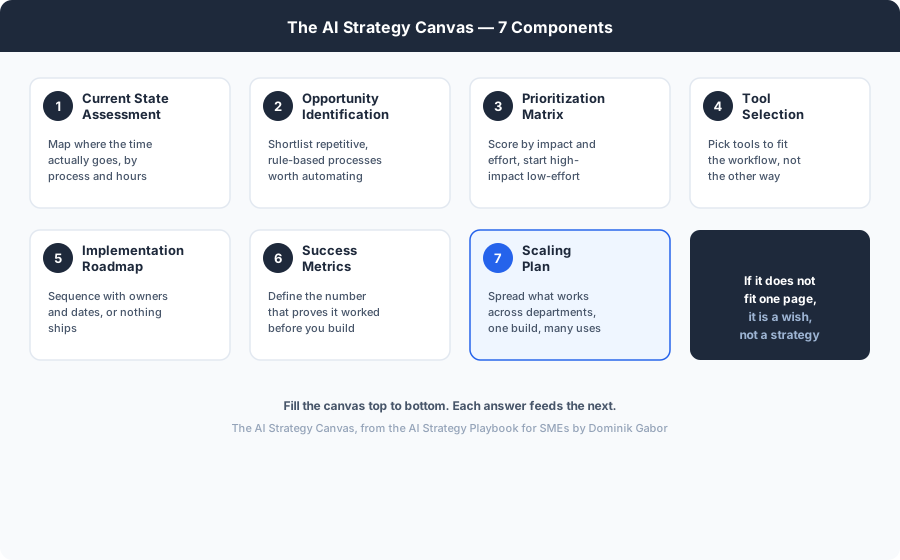
Save or share this, it's the full AI Strategy Canvas in one view.
Which process should you map first?
You already have the framework. In 30 minutes we run your Current State Assessment together and you leave with the first column of your AI Strategy Canvas filled in and a clear first move, no experimentation required.
- Your weekly processes mapped by real hours
- The highest-ROI workflow to automate first
- A phased plan you can start this week
30 minutes. No obligation. No pitch unless you ask for one.
Or grab the free AI Strategy Canvas template first →References
- The Marketing Centre. (2026). How to build an AI roadmap for SMEs: A practical guide for 2026. themarketingcentre.com
- MIT. (2025). The GenAI divide: State of AI in business 2025 [Study]. As reported in Entrepreneur. entrepreneur.com

About Dominik Gabor
AI Automation Consultant based in the Netherlands. Dominik helps small and mid-size businesses build and execute AI strategies, from the first mapped workflow to AI embedded across departments. He has spent 2+ years testing 27+ AI tools daily, and writes to give business owners the exact, practical starting points that most AI content skips over.