Why I Made This Series
For a long time, an LLM was a black box to me.
I wanted to understand what it is, what it does and how it works. So I started researching it.
What I found was mostly hype. Videos about closed-source models and how to use them to the maximum. Almost nothing explained what is going on inside. I was lost, and I could not find videos that explained it well.
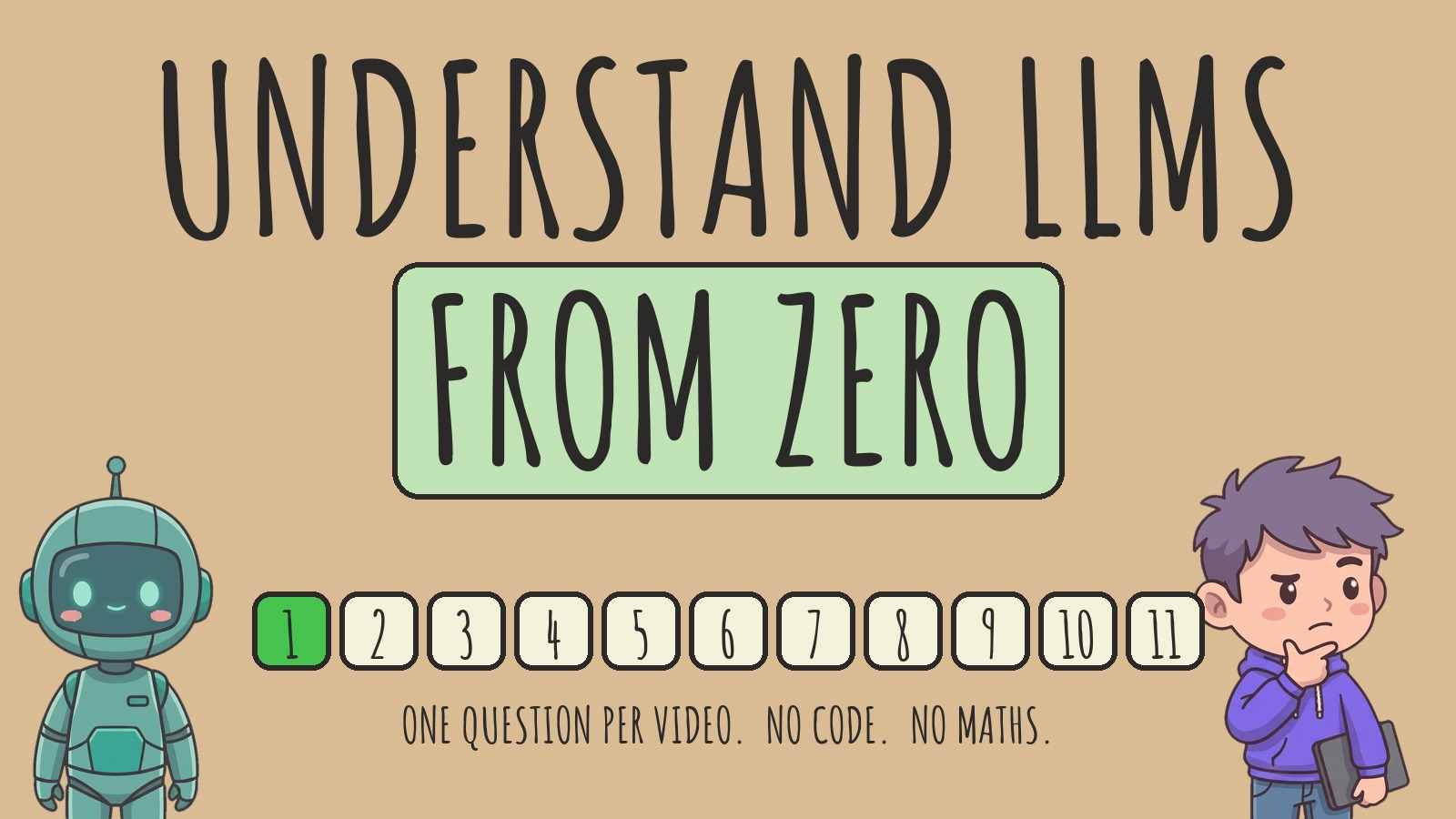
So I started making them myself. I wanted to teach other people what I had to dig for, from the ground up, in plain English. Eleven short videos, in order, about ten minutes each. No code, no maths.
I hope you like them, and I hope I can give you some value.
How the series is made
Every claim that an episode teaches is checked against a primary source first: the paper or the official documentation. Every token you see on screen is computed with OpenAI’s tiktoken library, not typed by hand. The narration is an AI voice (Google Gemini). The script, the research and the hand-drawn visuals are mine, and the sources for each episode are listed below and in the video description.
Key Takeaways
- An LLM does one thing: it guesses the next token, over and over.
- Tokens, not words. The model reads numbers, which is why spelling tasks and some languages trip it up.
- The same question can get a different answer, because every token is a weighted random pick.
- A raw model finishes text; it does not answer you. Assistants need extra training on top.
What Is a Token in AI?
A token is a chunk of text, often a whole word or part of one, that a large language model reads as a single number. One token is about three quarters of an English word, so 100 tokens is roughly 75 words.
Here is how GPT-4’s tokenizer (OpenAI’s cl100k_base, computed with the tiktoken library) splits the same two words in three ways:
| Text | Tokens | Token numbers |
|---|---|---|
| hello world | 2 | 15339, 1917 |
| Hello world | 2 | 9906, 1917 |
| hello world (two spaces) | 3 | 15339, 220, 1917 |
A capital letter or an extra space gives different numbers. The model never sees letters, only these numbers. That is why counting the r’s in “strawberry” trips it up: in GPT-4’s tokenizer, “ strawberry” is one token, number 73700.
Episode 1: How AI Reads the Internet
The question: What is a token, and why does ChatGPT see numbers instead of words? (live 14 October 2026)
To GPT-4, the words “hello world” are not words. They are two numbers: 15339 and 1917. The episode follows the internet step by step until it becomes that row of numbers.
- Labs start from crawls of the public web. One monthly crawl from 2024 holds almost 3 billion pages.
- Filtering turns that mess into about 44 terabytes of clean text, roughly 15 trillion tokens (the FineWeb dataset).
- Byte Pair Encoding merges the most common pairs of symbols until about 100,000 remain. GPT-4 uses exactly 100,277.
- English packs into few tokens. “Artificial intelligence is changing the world.” is 8 tokens in GPT-4’s tokenizer. The same sentence in Hungarian, “A mesterséges intelligencia megváltoztatja a világot.”, is 19, and AI is billed per token.
- This is why many models struggled to count the r’s in “strawberry”: they never saw the letters.
Watch Episode 1 on YouTube or read the full written walkthrough with 16 drawings: What Is a Token in AI? How ChatGPT Turns the Internet Into Numbers.
Episode 2: Guess the Next Token
The question: How does a neural network learn from that row of numbers? (scheduled 21 October 2026)
Every large language model starts with one guessing game, played on a dataset as big as 15 trillion tokens: read some text, guess what comes next, get corrected, repeat. That game is called next token prediction.
- The network scores every token in the vocabulary as the possible next one.
- Training nudges billions of knobs a tiny bit toward the right answer, thousands of times over.
- Nobody teaches grammar or types in facts. The skill comes out of the game.
Episode 3: Inside the Machine
The question: What happens inside a Transformer, without the maths? (scheduled 28 October 2026)
Picture a tower of DJ desks. GPT-3 has 96 of them, and every desk has its own knobs. Your tokens climb the tower, and on every desk they do two moves: listen back to the tokens before them (attention), then each one thinks on its own.
- Tokens become long lists of numbers with a stamp for their place in line.
- At the top, the last token’s list becomes a score for every possible next token.
- The model does not learn from your chat. The knobs were set in training.
Episode 4: How ChatGPT Writes
The question: Why does the same question get a different answer every time? (scheduled 4 November 2026)
A research lab asked an AI the same question 1,000 times, with its randomness turned all the way down, and got back 80 different answers. Every token comes from the spin of a wheel.
- The model turns your text into a percentage for every possible next token, the computer spins, and the loop runs again.
- Temperature reshapes the wheel, from predictable to wild. Top-p cuts away the tiny slices.
- A special end token, or a length limit, stops the answer.
Episode 5: What Is a Base Model?
The question: Why does the raw model not answer your question? (scheduled 11 November 2026)
In 2019, OpenAI trained GPT-2 on 8 million web pages. We asked it to help plan our week. It answered: “I’m going to be doing a lot of work on my blog.” It is not broken. It finishes the page you started.
- Pretraining gives you a base model: a machine that finishes documents.
- You can steer it by shaping the page: a quiz, a TL;DR, a script of a conversation.
- To get a real assistant, the model itself has to change. That is Episode 6.
Coming Next
- Episode 6: From base model to assistant
- Episode 7: Why AI hallucinates
- Episode 8: Why models need tokens to think
- Episode 9: How reinforcement learning works
- Episode 10: What RLHF really is
- Episode 11: The whole machine, from the crawl to ChatGPT
A new episode goes up every Wednesday at 17:00 (Amsterdam) on the TwinScale AI channel on YouTube. Each episode also gets a short post on LinkedIn, and this page is updated every Wednesday.
Why a Business Owner Should Care How This Works
You do not need to build a model. Three things in this series change how you use AI at work:
- Tokens are the unit you pay for. Language, length and formatting change the bill.
- The same question can get a different answer. If a process needs the same result every time, it needs a different design from a chat window.
- A model that finishes text is not a model that knows. Knowing what it was trained to do tells you where to trust it and where to check.
These are the questions I start from when I look at where AI would save a team hours. For the business side, see why 80% of AI projects fail and the complete guide to AI automation for SMEs.
Want this applied to your business?
If you run a company and want to know where AI would save your team hours, book a Free AI Profit Assessment. 30 minutes, English, no pitch.
- The manual work costing you the most hours
- The one process worth automating first
- An honest answer on what AI can and cannot do there
30 minutes. No obligation. No pitch unless you ask for one.
Sources for Episode 1
Every number in Episode 1 comes from one of these. Later episodes list their own sources in the video description and here.
- Penedo et al., The FineWeb Datasets (2024), and the FineWeb dataset card
- Common Crawl, September 2024 crawl archive (2.8 billion pages)
- Sennrich, Haddow and Birch, Neural Machine Translation of Rare Words with Subword Units (2016), the Byte Pair Encoding paper
- OpenAI, tiktoken, the GPT-4 tokenizer used for every token on screen, and Tiktokenizer to try your own text
- OpenAI Help Center, What are tokens and how to count them
- Andrej Karpathy, Deep Dive into LLMs like ChatGPT (2025), for the size of the cleaned web text
Frequently Asked Questions
What is a token in AI?
A token is a chunk of text, often a whole word or part of one, that a large language model reads as a single number. One token is about three quarters of an English word. To GPT-4, the words "hello world" are two tokens: 15339 and 1917.
How do LLMs learn?
By next token prediction. The model reads some text, guesses the next token, gets corrected, and repeats across trillions of tokens. Nobody teaches it grammar or types in facts. Episode 2 shows the game step by step.
Why does ChatGPT give a different answer each time?
Every token it writes is a weighted random pick. The model turns your text into a percentage for every possible next token, and the computer spins a wheel. Episode 4 shows that wheel with real numbers.
Do I need to know maths or code to follow the series?
No. Every episode is plain English with hand-drawn visuals, about ten minutes long, and starts from zero.
What is the difference between a base model and ChatGPT?
A base model is the result of pretraining. It only finishes text: ask it to plan your week and it continues the page instead of answering. ChatGPT is a base model that was trained further on conversations so that it answers. Episode 5 shows a base model failing and Episode 6 shows how it becomes an assistant.
Why does ChatGPT get letter counting wrong, like the r's in strawberry?
The model reads tokens, not letters. In GPT-4's tokenizer, " strawberry" is a single token, number 73700, so the individual letters are never in front of the model.
Is the narrator a real person?
The narration is an AI voice (Google Gemini). The script, the research and the visuals are by Dominik Gabor, and each video says so in its description.

About Dominik Gabor
AI Automation Consultant based in Leeuwarden, the Netherlands, and founder of TwinScale AI. He has spent 2+ years testing 27+ AI tools and builds AI automations for small and mid-sized companies. TwinScale AI explains AI from zero, with a new episode every Wednesday.