
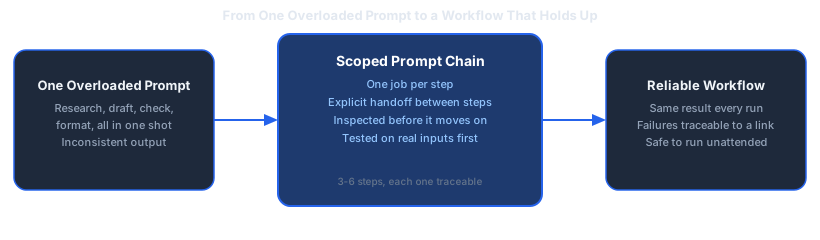
A single prompt asked to research a topic, write a draft, check the facts, and format the output will usually do all four badly. Not because the model is weak. Because no single instruction block can hold four different jobs' worth of context and stay precise about all of them at once.
Dominik Gabor, an AI automation consultant based in the Netherlands, sees this pattern constantly in client workflows: a business builds one enormous prompt, gets inconsistent output, and concludes that AI "isn't reliable enough" for the task. The real problem is almost never the model. It's that the task was never broken into steps small enough for the model to do well.
A prompt chain fixes this by treating a complex task as a sequence of small, testable jobs instead of one giant instruction. This post covers how to design a chain that holds up under real business use, the four patterns that cover most use cases, a full worked example, and the specific points where chains break in production.
A prompt chain is a sequence of separate AI prompts where the output of one step becomes the input of the next, instead of asking a single prompt to complete an entire complex task at once. Each step has one job, one defined input, and one defined output, which makes the chain possible to test, debug, and improve link by link rather than as one opaque block.
Key Takeaways
- Chains break at the handoff, not inside a step: the most common failure is an unclear format between step one's output and step two's expected input.
- 3 to 6 steps covers most business chains: beyond 8 steps, look for steps to merge rather than adding more.
- 4 patterns cover almost every use case: sequential, branching, parallel-merge, and feedback loop.
- The CHAIN-SAFE method: scope, handoff, inspect, test, and log, applied to every chain before it runs unattended.
- Test on 5-10 real examples before automating: including at least one deliberately malformed input.
Why Single Prompts Break on Complex Tasks
Every complex business task is really several smaller decisions stacked together. A "write a client update email" task is actually: pull the relevant facts, decide what matters this week, choose a tone, and format it as an email. Ask a single prompt to do all four in one pass and it will quietly skip or blend steps, usually without telling you.
The CRAFT Framework, developed by Dominik Gábor, solves this at the level of a single prompt: Context, Role, Action, Format, and Tone give one instruction the structure it needs to produce a consistent single output. A prompt chain applies the same discipline across multiple prompts. Where CRAFT makes one prompt reliable, chaining makes a sequence of prompts reliable together. For where prompt work fits into a wider automated business, see the complete guide to AI automation for SMEs.
The tell that a task needs a chain, not a single prompt, is simple: if you can't describe the desired output in one sentence without using the word "and" more than once, it's more than one job.
What a Prompt Chain Actually Is

Mechanically, a prompt chain is nothing more than: run prompt one, take its output, insert that output into prompt two as a variable, run prompt two, and repeat. What makes a chain good or bad is not the mechanism. It's whether each step is scoped correctly and whether the handoff between steps is explicit.
A weak chain link looks like this: step one produces a paragraph of loosely structured notes, and step two's prompt says "use the notes above." The model has to guess which parts of the paragraph matter. A strong chain link names the exact fields step one must produce, and step two's prompt references those fields by name.
Step 1 output: a paragraph summarizing the client call.
Step 2 prompt: "Using the summary above, draft a follow-up email."Step 1 output (JSON): {"decisions": [...], "action_items": [...], "open_questions": [...], "sentiment": "positive|neutral|concerned"}
Step 2 prompt: "Using decisions={{decisions}} and action_items={{action_items}},
draft a follow-up email. If sentiment is 'concerned', open by
acknowledging the open question before listing next steps."The second version works the same way every time because step two never has to interpret free text. It reads named fields. That single change, structured output instead of prose, fixes most of the inconsistency people blame on the AI model itself.
4 Prompt Chain Patterns and When to Use Each
Most business chains fit one of four shapes. Picking the right shape before you start building saves a rebuild later.
| Pattern | Structure | Best for | Typical length |
|---|---|---|---|
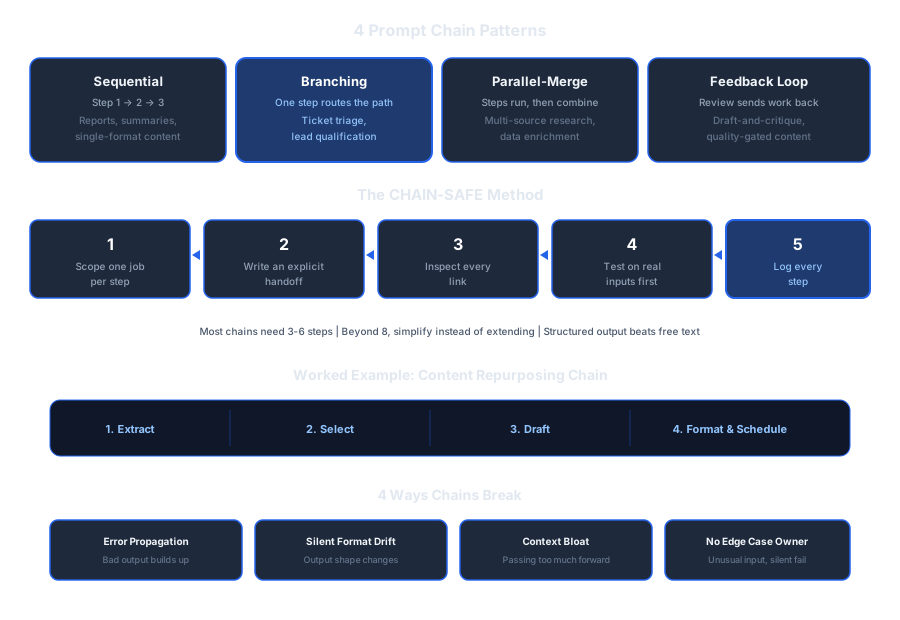
| Sequential | Step 1 → Step 2 → Step 3, one path, no branches | Reports, summaries, single-format content generation | 3-5 steps |
| Branching | An early step routes to one of several downstream paths | Support ticket triage, lead qualification, content moderation | 4-6 steps |
| Parallel-merge | Several steps run independently, then one step combines the outputs | Multi-source research, competitor analysis, data enrichment | 4-7 steps |
| Feedback loop | A review step sends output back to an earlier step until it passes a check | Draft-and-critique writing, code review, quality-gated content | 4-6 steps (per pass) |
Sequential is the default and the easiest to debug: start there unless the task clearly needs a decision point (branching), multiple independent inputs (parallel-merge), or a quality gate that can send work back (feedback loop). Most business chains that "feel complicated" are actually a sequential chain that someone tried to force into one giant step instead of five small ones.
Worked Example: A 4-Step Content Repurposing Chain
Here is a complete sequential chain, the kind a marketing team would run in n8n, that turns one long blog post into a week of LinkedIn content. For how n8n compares to writing the same workflow in code, see Claude Code vs n8n. Here it is broken down link by link.
Step 1 – Extract: Claude reads the full blog post and extracts a structured list of the 5-8 most shareable claims or insights, each tagged with a one-word theme.
Step 2 – Select: A second prompt receives the extracted list and picks the 3 strongest claims for this week, based on variety of theme and how well each claim stands alone without the surrounding article context.
Step 3 – Draft: For each selected claim, a prompt drafts a standalone LinkedIn post in Dominik's voice: short punchy opening line, one supporting example, one closing question.
Step 4 – Format and schedule: A final prompt checks each draft against a fixed checklist (character count, no em dashes, one question at the end, no forbidden vocabulary) and flags anything that fails before it reaches the content calendar.
Read the blog post below. Extract 5-8 claims or insights that
would work as standalone social posts.

Output as JSON only:
{"claims": [{"text": "...", "theme": "one word"}]}

Rules: each claim must make sense without the rest of the article.
Do not invent claims not present in the text.

Blog post: {{post_text}}
Notice each step outputs structured data (a JSON list, a selected subset, formatted drafts), not a loose paragraph. That is what makes step 4 possible to build reliably: it is checking specific fields, not re-reading prose and guessing at intent.
Setup time for a chain like this, once you already have the individual prompts drafted, typically runs 3-5 hours in n8n: one node per step, plus a manual review step before anything gets published. The time is not spent wiring the nodes together. It is spent iterating on the prompt for each step until its output is consistent across a range of test posts.
The CHAIN-SAFE Method
Five habits separate chains that run unattended for months from chains that quietly produce wrong output and nobody notices for weeks.
- Scope each step to one job. If a single step's prompt needs the word "and" to describe what it does, split it into two steps.
- Write an explicit handoff. Define the exact fields and format moving between steps. Structured output (JSON, a fixed list) beats free text every time.
- Inspect every link. Add a lightweight check between steps, even a simple format validation, that confirms the output matches what the next step expects before it moves on.
- Test the full chain on real inputs. Run it end to end on 5-10 real examples, including at least one deliberately messy or incomplete input, before switching it on for production use.
- Log every step. Store the input and output of each step. When something breaks three weeks from now, you need to see exactly which link failed, not just that the final output looked wrong.
None of these five habits are complicated on their own. What makes chains fail is skipping one of them under time pressure, usually the testing step, because the chain "worked" on the first two examples someone tried.
The 4 Ways Prompt Chains Break in Production
Chains that pass initial testing still break later, and it's almost always one of four patterns.
1. Error propagation. Step one produces a slightly wrong output. Step two doesn't validate it, so it builds on the mistake. By step four, the final output looks confidently wrong, and there is no clear signal that anything went off track. This is why the "inspect every link" habit exists: catching a bad output at step one is far cheaper than debugging a bad output at step four.
2. Silent format drift. A model update or a slightly different input causes step one to change its output structure in a small way, an extra field, a renamed key, a list instead of a paragraph. Step two, which was written assuming the old format, either fails loudly or, worse, fails quietly and produces degraded output. Structured output with a fixed schema reduces this, but it doesn't eliminate it. Periodic spot checks still matter.
3. Context bloat. Long chains sometimes pass the entire history of every prior step into every subsequent step "just in case." This slows every step down, increases cost, and can actually reduce accuracy because the model has to sift through irrelevant context to find what matters. Pass forward only what the next step actually needs.
4. No owner for edge cases. A chain built and tested on typical inputs handles the typical case well and breaks silently on the unusual one, a client name that doesn't parse, an empty field, a non-English input. Someone on the team needs to own noticing when the chain's output looks wrong, at least until it has run reliably for a few weeks.
These are the chain-level versions of the same failures that sink automation projects generally, which why 80% of AI projects fail covers at the project level.
Testing a Chain Before You Automate It

Before a chain runs unattended, test it manually against a small, deliberately varied set of inputs. Five to ten examples is usually enough to surface the failure modes above without spending days on it.
- 2-3 typical inputs that represent the most common case the chain will see.
- 2-3 edge-case inputs that stretch the chain: unusually long, unusually short, or missing a field the chain expects.
- 1-2 deliberately malformed inputs to confirm the chain fails visibly rather than producing quiet garbage.
- 1 realistic worst case based on whatever has actually gone wrong with this process before you automated it.
If every run produces a usable, correctly formatted result, and the malformed input produces a visible error rather than a confident wrong answer, the chain is ready to run without a human reviewing every output. If not, the failing case tells you exactly which link needs a clearer handoff or a stricter check.
For Dutch and German SMEs building these chains in n8n, the same self-hosting logic applies as with any other AI workflow: running the chain on a self-hosted n8n instance keeps every intermediate step's data on your own infrastructure, which matters when a chain is processing client emails, contracts, or support tickets rather than public content.
Two years of testing 27+ AI tools daily taught Dominik the same lesson at the chain level that CRAFT teaches at the prompt level: the wiring between tools is the easy part. The handoff between steps is where reliability is won or lost.
Frequently Asked Questions
What is a prompt chain?
A prompt chain is a sequence of separate AI prompts where the output of one step becomes the input of the next, instead of asking a single prompt to complete an entire complex task at once. Each step has one job, a defined input, and a defined output, so the chain can be tested and debugged link by link.
How many steps should a prompt chain have?
Most business prompt chains work well with 3 to 6 steps. Guides on the topic generally suggest that chains longer than about 8 steps become hard to debug and should be reviewed for opportunities to merge or simplify steps. Start with the smallest chain that solves the problem, then add steps only when a single step is clearly doing two jobs.
What is the difference between a prompt chain and an AI agent?
A prompt chain follows a fixed, predetermined sequence of steps that you design in advance. An AI agent decides its own next step based on the situation, which makes it more flexible but harder to predict and test. For most repeatable business processes, a fixed chain is more reliable because every run follows the same path and produces a comparable result.
Why does my prompt chain produce inconsistent results?
The most common cause is an unclear handoff between two steps: the output of step one does not specify the exact format step two expects, so the model guesses. Other common causes are one step trying to do two jobs at once, and errors from an early step silently passing through instead of being caught before they reach the next link. See the 4 ways prompt chains break in production above.
Do I need to code to build a prompt chain?
No. Tools like n8n let you build a prompt chain visually: each step is a node, and the output of one node connects to the input of the next. You write the prompts and define the handoffs, but you do not need to write code to wire the steps together.
The Bottom Line
Prompt chains solve the problem single prompts can't: complex, multi-step business tasks that need to run the same way every time. The chains that hold up in production are not the cleverest ones, they are the ones where every step has one job, every handoff is explicit, and someone tested the chain against messy real-world input before switching it on. Start with a sequential chain of 3-4 steps on a task you already understand well, then apply the CHAIN-SAFE method before you automate anything that touches client-facing output.
Chaining is the natural next step after single-prompt discipline. If the CRAFT Framework got your prompts producing consistent single outputs, chaining is how you connect those outputs into a workflow that replaces an hours-long manual process with a few minutes of review.
The Complete Picture
Save or share this – it's the full breakdown in one view.
Find out which workflow is worth chaining first
Not every repetitive task needs a 5-step chain. In 30 minutes we map your most time-consuming multi-step process and identify exactly where a chain would replace hours of manual work, and where a single prompt is enough.
- Which process actually needs a chain
- Where your current AI workflow is likely breaking
- A realistic setup timeline for your tools
30 minutes. No obligation. No pitch unless you ask for one.
Or grab the free resources first →
About Dominik Gabor
AI Automation Consultant based in the Netherlands. Dominik helps small and mid-size businesses across Europe implement AI automation, from single-prompt frameworks to full multi-step workflow chains. He has spent 2+ years testing 27+ AI tools daily, and writes to give business owners the exact, practical starting points that most AI content skips over.