12-Month Cash Flow Forecast Template for Excel
Your bank asks what next year looks like. Type last year's numbers, set four assumptions, and the sheet shows the month your bank balance gets lowest.
Free. No email, no sign-up.
How to use it
- Assumptions tab: fill in the blue cells. Bank balance today, the first forecast month, sales growth, how many days your customers take to pay, materials as a share of sales, and the lowest balance you are comfortable with.
- Last year tab: type last year's numbers by month. Sales means what you invoiced, not what came in. Your bookkeeping software's profit and loss report has most of them.
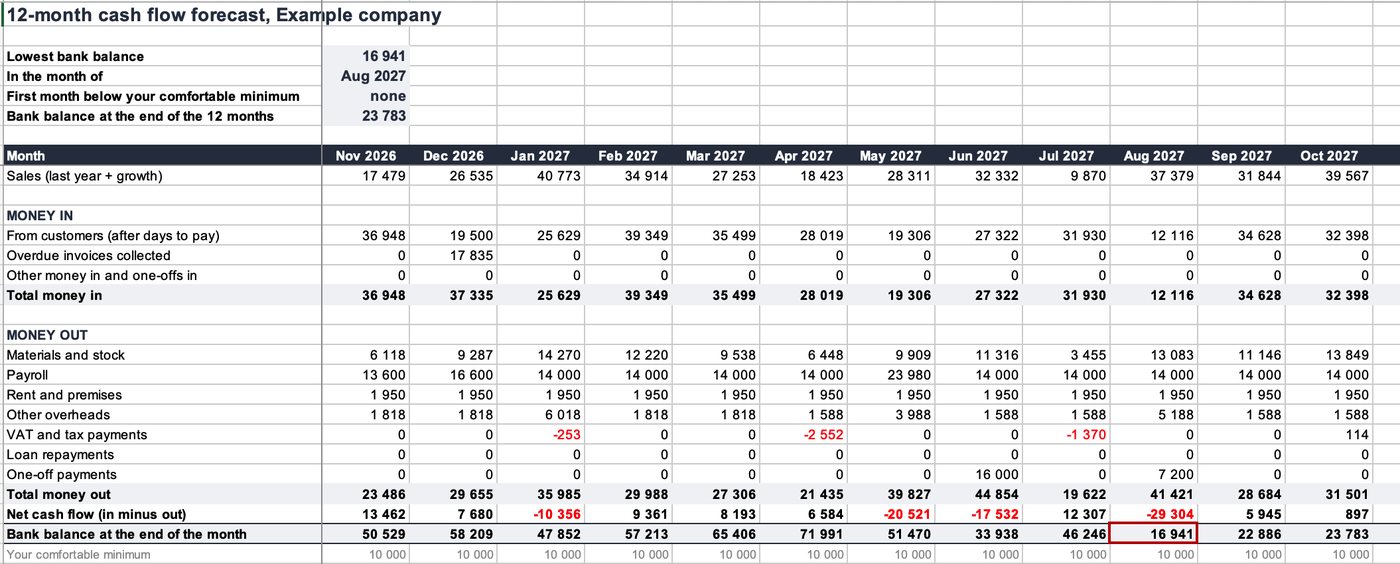
- Forecast tab: read the lowest bank balance and the month it happens. Then change one assumption and watch every month after it move.
Try this first: set "Include it in the forecast?" to No. That is your year if the overdue invoices never come in. In the example, August drops from 16,941 to minus 894.
What is inside
| Tab | What it does |
|---|---|
| Start here | The three steps and how the model works, in plain English. |
| Assumptions | Every input in one place, plus an overdue-invoices switch and a table for one-off payments like a new machine. |
| Last year | Twelve months of sales, payroll, rent, overheads, VAT and loan repayments. |
| Forecast | Money in, money out and the bank balance for 12 months, the lowest month, the first month under your minimum, and a chart. |
What the model assumes
It is a simple model on purpose, so you can see every step.
- Sales follow last year's months, plus your growth. A slow July last year means a slow July next year.
- Money in arrives after your average days to pay. At 33 days, 90% of a month's sales arrive the next month and 10% the month after.
- Payroll, rent and overheads repeat last year's months, so holiday pay, bonuses and yearly bills land where they did.
- Materials scale with sales. One-offs go in the month you type.
The example numbers belong to a made-up company. Replace them with yours, row by row.
Want this built from your own books?
I set up AI systems for owner-run companies: the forecast built from your bank export and updated every month, so the tight month shows up while you can still act on it.
See my servicesThis template is a planning tool, not tax, legal or financial advice. Check the result with your accountant.